Table of contents & month archives:
Archives
The Tetrast2 - Speculation Lounge • The Tetrast3 - Bits • What of these other fours?
The various Tetrast blogs are best viewed in Internet Explorer or Firefox (at least as of my recentest opportunity to compare various browsers on various platforms).
First posted on Monday, September 25, 2006—
Compare to Aristotle, Aquinas, & Peirce.
Latest significant change: June 25, 2009.
• The Four Causes (see Aristotle’s Physics II 3 and Metaphysics V 2) and related principles (agent, patient, act, and, as I argue, the borne);
• The Categories (e.g., substance, modification, modality, relationship, etc.; and Peirce’s firstness, secondness, thirdness);
• Elements of logical psychology (e.g., explanation, analysis, inference to a concept, inference to a judgment);
• Elements of logical process (semiosis) (e.g., object, sign, interpretation, and—fourthly—verification);
• Modes of inference (e.g., surmise, induction, deduction through one-way implication, deduction through equipollency);
• Requisites for beauty (e.g., due force, harmony, radiance, integrity);
• Elemental modes of the psyche (formerly also known as faculties or powers of the soul), with some discussion of a structural likeness to special relativity's light cone; and
• Classification of the sciences (and of mathematics), involving distinctions such as the inadequate one into nomological, classificatory, and descriptive fields, which glosses over the difference between chemistry and biology and seems related to an undue eclecticism about logical quantities.
I add a discussion of “beginning, middle, end, check/entelechy” and the Four Causes’ Principles (agent, patient, etc.) below the first set of tables. After that I discuss and compare Peirce’s classification of research to the tetrastic one (i.e., mine). Update: My most recent discussion of the Four Causes is at this link.
Note that, in the Tetrastic table on the Four Causes and related principles, the items within a given column are not all to be flatly equated with one another. Nevertheless, each of the four columns is structured in parallel with the other three.
Note: Peirce seemed a bit reluctant to use the word “accident” among the categories, perhaps because of the word’s double sense of coincidence (a mode of attribution) and descriptive attribute (see the Catholic Encyclopedia entry on “accident”). Why not an alternative like “property” or “attribute”? Maybe because: “Property” originally meant something like “idiosyncrasy” (not in the sense of “quirk,” but simply of “special but non-essential”); and, through Aquinas and others, "attribute” acquired a sense of “essential attribute.” Either way, too much narrowing of the attributional mode. Also, an attribute could be a thing (e.g., a hand), not just a property or quality. I long used “accident” in accordance with Peirce. I’m not quite happy with “attribute.”
Some have classed desire (a feeling) outside of the feelings and instead as a kind of will or conation. Yet, the similarity between will/conation and the feeling of desire is part of a pattern. The 4x4 table above is a systematic fairground of similarities and dissimilarities. Consider for instance the column under “Will, Conation” vis-à-vis the column under “Affectivity.” Desire does resemble trying. Yet likewise, for instance, (affective) attachment resembles (volitional) adherence. Hence, to reclassify desire as a mode of will invites a general reclassification of affectivity as volition. But perhaps trying is the archtypical mode of will?—such that a resemblance to trying is a sign of being a mode of will? Yet even if one grants that there is something to that idea, why assume that the scenario depicted in the idea is unique? One also might regard memory, recognition, and knowledge as archtypical cognition. Maintenance and skill resemble them. In fact the English words “can,” “ken,” and “know” are cognate. Are maintenance and skill really cognition, while testing, preparation, and achievement are not cognition? No, and instead, it makes more sense and is more interesting to trace out the larger emerging pattern. In considering whether to conflate will/conation with desire, it’s good to consider the broader picture and to make sure of having done adequate inventory.
The times “almost now,” “later,” “barely now, just now,” and “earlier”, mentioned in the above tables, point to a generalization from the ubiquitous physical case of relativity’s light cone. Now, we say, roughly speaking, that one’s past affects one’s future but not vice versa. Should we likewise distinguish the present which one affects and the present which affects one? Aren’t they pretty much the same zone with respect to the somewhat prolonged present which a mind actually experiences? Yet they turn out to be worth our distinguishing as times far oftener than we do so.
The initial point is:
• to recognize the philosophical generality of the idea of a finite general upper speed limit and the general import, for any system of communication and cause/effect, of finite general practical upper limits on the speed of signal propagation, though the given medium’s effective speed limit be less high and exact than some ultimate physical limit like lightspeed, and
• to recognize that mutually causal relationships involved with co-present objects don’t absolutely unite outgoing potency and incoming information, don’t render them indistinguishable in a wash of instantaneity -- don’t actually so unite them any more than they phenomenologically so unite them (as is more easily noticed from the viewpoints of the objects involved; compare with Merleau-Ponty’s idea of the never completed circuit between touching and being touched and even between touching oneself and being touched by oneself). Instead, two “presents” differ like future and past, differ as the respective edges, surfaces, of future and past. The difference runs deep -
Then we can see, in parallel, (a) the future as an entrainment, or as a continuous unification, of successive almost-nows, and (b) the past as an entrainment, or as a continuous unification, of successive just-nows. This can be seen systematically reflected throughout the tetrastic 4x4 table (above) of time-orientational modes of the psyche, in the columns under will, dealing, affectivity, and cognition. For instance, we can see (a) a seeking as a unity arising across successive tryings, and (b) an adhering as a unity arising across successive takings or pickings.
* * *
• If the decision-making, the beginning, is regarded as a kind of main cause, those middles appear, relative to the situation of interest, as intermediate causes, helpers, facilitating causes. Of course they’re also intermediate effects. In any case we regard them as means.
• If the end is achieved, effected, sometimes it’s so directly obvious that we don’t think of any checks as being involved. But often enough there are collateral and at least a bit later things or events to which we look. If the end is regarded as a kind of main effect, those things or events “on the side” or further in time appear, relative to the situation of interest, as side effects, after-effects, evidentiary effects, checks.
Just as in advance one may have desired and hoped for the end, likewise one may have imagined and anticipated the collateral effects, the evidences, e.g., wakes, trails, tracks, shells, etc. One then also will have hoped for them, but only because one hopes for them as signs of the end’s having been achieved. They aren’t means to the end, they’re beyond and in addition to the end in a rather similar sense as the means are beyond and in addition to the beginning, the decision-making. And, just like an end, a check can be prospective, not yet accomplished.
We often think of an agent cause as compelling. That’s an affinity, not a rigid rule. One could also stand physically willing but not insistent for motion, and thus one will amount to a contributing agent cause of one’s motion if one does move. But let’s focus on the typical affinities among ideas. By pushing oneself, in the sense of pushing against the hardly movable ground for example, one compels one’s own motion, with a kind of physical insistence. On the other hand, we regard means as enabling rather than compelling. (The particular means may be necessary or, thanks to alternatives, unnecessary.) Now, let’s use this pattern of affinities in order to flesh out the conception of the “check,” the establishment or settlement or confirmation, as a cause. Given a goal, a prospective end or satisfaction, there is a necessity — not a compulsion but a kind of needfulness — for a means. Now, what conception stands to needfulness, as enablement stands to compulsion? A kind of reasonableness. Given that it will be established or practically knowable (at least by oneself if not by others, or even vice versa) and be a basis (for knowledge or whatever), one has reason to do something, that is, it’s reasonable to do it, in the sense that it will be real or solid or legitimate or in evidence. Why do it if it’s such that it might as well be unknown by anybody ever? Of course, sometimes one does something because it will be off the record or hidden or transitory or somehow not for real (and others will not know of it). But that is weak counter-example because the same kind of weak counter-example has always occurred in the case of goals: sometimes one does something because others will not care about it or even because it will block their aims. One note: just as an end or goal is not only about pleasure but first of all about the good — otherwise we might as well just attach electrodes to our brains' pleasure centers — likewise the check is not only about knowing and wakefulness, but first of all about the real, the legitimate, etc. To the problematics of goals, pleasures, pains, indifference, and of people acting against their own interests and ends, I come bearing reminders of the problematics of checks, knowledge, ignorance, deception, and of people acting as their own unwitting accomplices.
As a middle, a continuing, is like a staying-begun, so a check is like a staying-ended. There’s some nice simplicity and symmetry about these ideas, even as they incorporate asymmetry. We live in time-asymmetric world in which the check, the hold, the staying-ended (and, so to speak, its content) which follows upon a thing’s ending pertains to that thing more specifically, more informatively, than does a hold or holding-off which precedes the thing’s beginning. This and other asymmetries seem to have their part in the symmetries that abound.
Of course, just as a means can secondarily be an end and vice versa, so a check can secondarily be a means and vice versa, and likewise so can a check secondarily be a beginning, a decision point, etc.
The check or entelechy amounts to a kind of confirmation of things which might have been illusory or transitory. In a broader sense than is usual for the word “entelechy,” one can consider wakes, tracks, trails, shells, husks, etc., as entelechies, or as outcroppings of an entelechy of the situation.
However, the traditional emphasis, in the conception expressed by the term “entelechy,” has been on the entelechy as a having COMPLETE (or a holding or being COMPLETE), fully and not just partly actualized — rather than on entelechy as a HAVING (or HOLDING or BEING) complete - a standing finished - in a settled completion that can stand up to trials. It’s been enTELechy instead of entelECHY. That traditional emphasis on fullness of actualization (rather than on solidity, establishment), going back to the term’s orginator Aristotle, has permillennially missed something of the confirmational aspect, I think.
Hard it is to become good, harder still to stay good — that sort of thought seems to have been at the root of it, so it’s good to remember that, in a practical sense, what’s involved in staying good is not only that one fully has the good, but also that one’s good is firm and can stand up to reality’s trials and tests, whether they come thick and fast, or otherwise. It’s a good which is tried and true.
Moreover, it is simpler to regard entelechy in that way, as being a distinct principle, something further than a being-fully-completed, since one already regards the middle as being something further than a being-fully-begun. The analogy is exact down through its foundations, as will be seen in a moment. One must be regardful of the systematic conceptual structure of stayings and becomings which undergird these ideas.
Which brings us to the following:
One might object that “beginning, middle, end” seems so nice and complete; why add something more? Beginning, middle, end, like start, continue, stop.
Logically, however, it doesn’t seem so nice and complete at all. Instead:
Beginning, like starting at time t
— X occurs? no (for some period) till t, yes (for some period) since t.
Middle, like continuing at time t
— X occurs? yes (for some period) till t, yes (for some period) since t.
End, like stopping at time t
— X occurs? yes(for some period) till t, no (for some period) since t.
Check, like refraining, holding at time t
— X occurs? no (for some period) till t, no (for some period) since t.
Now that’s logically nice, complete, and hardly escapable, exhausting the combinatorial possibilities of the two relevant parameters.
The entelechy is traditionally associated with the form. Now, a structure is an equilibrium (be the equilibrium static, harmonic, or whatever else) among forces with some stability. Therefore the structure of a thing - even with all the mobility, flexibility, etc., which the structure may have - is a settlement or establishment of the thing, and is the kind of form (as opposed to form as aspect, figure, quality, etc.) most suited to be regarded as the entelechy. While the good has the rational character of an end, a culmination, on the other hand the true, the sound, the legitimate, have the rational character of a check, an entelechy.
It is also possible to make an entelechy the end, goal, culmination of one's action, as when one acts in order to prove something - maybe in inquiry, but also, for instance, about oneself in daily life, acting to prove oneself as being legitimately this or that, deserving of some sort of recognition or honor or accorded status, or to prove that some people do or don't deserve some status. (How many times, in practical matters, have you heard one person ask another, "what are you trying to prove?")
One can make a goal of any of the four causes, and there are 'arenas' of contention for them -
For instance one makes a goal of a beginning, a deciding, a leadership, when one vies or contends in group or mass decision-making for a decision or for a way of decision-making (politics, military battle, etc., deciding who or what gets to decide, etc.).
If it's a vying to have or be means in general, then it's for wealth, wherewithal, (e.g., business, commerce, finance, etc.) .
If it's a vying to have or be ends in general, a vying to be valued, then it's for glamour, glory, wattage, splendor (e.g., fashion, sports, popularity, notoriety, opulence, "hipness," etc.).
If it's a vying to have or be entelechies in general, a vying to be legitimized, then it's for honor, standing, etc. (e.g., case-building, discussion, debate, the formation of common opinion).
The “agent-patient” distinction was discarded long ago in fields like chemistry, yet the ideas remain useful for informal discussion. They could be more useful if they were conceived more systematically.
The agent acts on the bearer a.k.a. patient, e.g., matter, and, to the extent that the bearer suffers through to a completed change, that completed change is the act. Agent-patient-act: the ancient philosophical tradition.
(In the case of "rest" or stasis imposed by the agency, I'm not aware that Aristotle discussed "completed" stasis or the like, but suitable ideas seem to include that of a stasis culminating in some event and that of a stasis with the potential energy of the event in which it would culminate.)
We come to a fork in the road as to the meaning of the ancient Latin verb pati, “to bear,” “suffer,” etc. — (1) “to endure, to bear up under,” and (2) “to undergo, to yield up to.” (The ancient Greek paschein had pretty much the second meaning.) A thing may to various extents both endure and yield. The first sense is primary for pati and may be associated with not only endurance but also spiritlessness, a kind of inertia; the second sense is tied to the idea of act, the driven, which, in a sense, is opposite to the patient, its patience, the enduring; the two opposed ideas are of aspects of duration, ideas, respectively, of temperate versus vigorous, and, respectively, of enduring versus briefening. As the ideas of patience and act are temporal, so the ideas of agency and, opposed to it, borneness, are spatial ideas, involving magnitudes with directionality and directional opposability. The agent is an impetus for process, development, becoming, eventuating in act. The old tradition defined ongoing change, shift, spatial or otherwise, which it called “motion,” as the state of being between potency and act. But underlying an agency is an even simpler role of mover, impeller, imparter of spatial motion which is not itself a process culminating, by its own incubative nature, in act. Spatial motion and rest (stationariness) are relative; and simple uniform motion is a changing of distance-defined relative location, which continues indefinitely if not interrupted. This is travel, not duration, and pertains most directly to an agent’s driving and impress, rather than to a patient’s enduring and incubating. (The traditional idea can be saved to a small extent: potency: a thing is at rest in its own reference frame; motion: then it gets hit and now travels or is at rest in a changed reference frame; act: finally it collides with something.)
A wrench in the works is that the word “passion” succumbed fully to the second sense of pati, the sense of “to undergo, to yield up to.” The act (or action qua act, as distinguished from action qua operation, impelling, driving) which is the acted-on-ness is, by that very stroke, the “passion” of the patient, and differs only in its perspective; the passion is the act as regarded from the receiving end, while the act is said as a deed to be of the agent, though the word “act” comes from a passive participle meaning “been made or driven.”
Anyway, this semantic choice about the word “passion,” the traditional one, obscures the more meaningful distinction outlined above between the act and the borneness, one whereby the end can be distinguished from the form at the level of causes' principles, as act and borneness.
The patient hardly exists as a patient except so long as the balance, supportedness, stability of agencies in its system — the agencies which the patient contains or has internalized — are there in some significant measure. If instead the patient yields up fully and thoroughly, it will be converted to pure act, like matter into kinetic energy. A patient may yield (pati in the second sense) fully to an agent, but basically a patient is an endurer (pati in the first sense), and a borneness is an agent’s corresponding balancement. Now, that is to make borneness sound like balanced internal agencies. Far from objectionable, that is desirable, (a) since the idea of balanced internal agencies obviously pertains to the idea of structure and therefore of the formal cause, which thereby at last has a distinct causal principle in borneness, and also (b) since nothing is wrong and something is right with agency and borneness being in some sort of equivalence, when patience and act are in some sort of equivalence. The bearer (or its patience) is in a sense internal act, internally stored, tempered act, internal vigor, in latent and patent modes, which comprises the temper and patience of a whole. For instance, rest mass (correlated to proper time, “own duration”) is equivalent to rest energy (though in order for this analogy to work in terms of the primitive terminology of “agent, bearer, acted-on, borne,” one must, among other things, consider momentum as impulse which is a suitably more “agential” idea than that of momentum per se).
The resultant tetrachotomy is a kind of square of oppositions of causes’ principles, with an axis of space along the downward diagonal, and an axis of time along the upward diagonal.
agency ~ ~ act
~ ~ ~ ~ X ~ ~ ~ ~
bearing ~ borneness
Moreover it’s worth noting that, logically, insofar as agent & patient are like “maker” and “allower/supporter,” their conceptions are subject to logical inter-transformability like their kindred conceptions necessity and possibility in simple parallel.
Why it is, that agent and patient should both of them be principles of change yet their passive-voiced versions should not, likewise unconflated, both of them be principles of change, is a question which has unfortunately gone largely unnoticed, so far as I know. It’s especially unfortunate insofar as it seems that, for the various already noted reasons, the borneness is just as valid a principle as agent, bearer, and act. Occam’s Razor isn’t blind and won’t cut here; to the contrary, if agent is the driver and act the driven, and if bearer is endurer, then borne is the endured, not the driven. The value of the simplicity of consistency should have led reasoning along this road long ago.
The agency is an initiation of change or rest (or arrest), the patience is a mediation of change or rest, the act is a culmination of change or rest, and the borneness is a settlement or resolution of change or rest. Thus those four terms reassuringly parallel the gamut of logical possibilities of change’s starting, continuing, stopping, refraining.
Note: It is not necessarily that there are always two things, agent and bearer, in various roles; one same thing may be agent and bearer; and the acted-on in question may be or become separate from the bearer in question; some of an agent’s agency may be internalized by the bearer and become stably balanced within it, in a restructuring; and so forth.
1. Agency ―――› will & character. ~ ~ ~ ~ 3. Acted-on-ness ―› affectivity & sensibility.
2. Bearership ―› dealing & competence. ~ 4. Borneness ―――› cognition & intelligence.
On a level where one distinguishes between will and affectivity, one should make also the same distinction between dealing (trectation, dealing-with) and cognition. It’s like the distinction between efferent (as with efferent nerves carrying signals out from the brain to the muscles) and afferent (as with afferent nerves carrying signals to the brain from sensory receptors).
Similarly, on a level where one distinguishes either (1) dealing-with from will or (2) cognition from affectivity, on that level one should make both distinctions. Between members of each pair there is a difference like that between the indirect (e.g., finesse) and the direct (e.g., force), or between that which is stabilized or steadied within a system and that which is otherwise in its involvement with the system.
We depend on checks or stages of checkedness a great deal and at least somewhat radically, anyway deeply. Our deep dependence on them is what separates us from purely instinctual animals and from vegetables, whose adjustments and adaptations in responses to conditions are pre-programmed and stop short of points beyond which we speak of design adaptations, which require evolution or intelligence and learning. We’re not quite to the point of redesigning ourselves biologically but we redesign much in our world. If a vegetable’s decoding of a signal is “disconfirmed,” then this heightens its odds of leaving the gene pool — the signal’s ‘recipient’ is in a sense the evolutionary process, which, in its trial-&-error way, is the only thing there doing anything like learning. We have brains and are sufficiently unbound to particular codes and systems of interpretation, sufficiently that we can test, check, renovate, redesign our interpretations and systems of interpretation, at least somehwat, rather than leaving that job mostly or entirely to biological evolution. And thus it is that intelligence involves verification, confirmation, inference processing rather than merely calculation, curve-fitting, information processing, and likewise it is that intelligence is not merely telic but distinctly entelechic (confirmational, etc.) and that its forms and structures do not merely instrumentally follow function but instead also record and evidence, for the intelligence itself, a function’s accomplishment, and also much more.
Yet, aren’t such evidencings and recordings a function and value? And isn’t the form then still a kind of means, following function? The answer to both questions is yes, especially from the biological viewpoint. Conversely, from the intelligential viewpoint, functions, goals, and their means can be evidentiary and can be legitimacies and bases for legitimacies. Beginning, means, end, check — each of these can work and be multifariously, in a metaboly and evolution of hows and whys. In the elementary case, the evidence of a goal’s accomplishment is not a means to that goal, nor is it that goal itself. It is also a means, an end, etc., in merely the same sense that a means itself can be a secondary end and vice versa. If one pays attention to the explanatory frame, and does not play fast and loose with shifts of reference, then it becomes clear that the entelechy, the settledness, is an original relationship not understandable merely as beginning, means, or end, and can be regarded as a kind of transformation of any of them only in such sense as the sense in which they can be regarded as transformations of one another.
Another discussion: "Mining Aristotle's Four Causes for order & balance."
Latest significant change: June 25, 2009.
Here are tables
for comparison of my little systems to systems of Aristotle, Aquinas, and C.S. Peirce, in an easy way to look at. The comparisons are in regard to:• The Four Causes (see Aristotle’s Physics II 3 and Metaphysics V 2) and related principles (agent, patient, act, and, as I argue, the borne);
• The Categories (e.g., substance, modification, modality, relationship, etc.; and Peirce’s firstness, secondness, thirdness);
• Elements of logical psychology (e.g., explanation, analysis, inference to a concept, inference to a judgment);
• Elements of logical process (semiosis) (e.g., object, sign, interpretation, and—fourthly—verification);
• Modes of inference (e.g., surmise, induction, deduction through one-way implication, deduction through equipollency);
• Requisites for beauty (e.g., due force, harmony, radiance, integrity);
• Elemental modes of the psyche (formerly also known as faculties or powers of the soul), with some discussion of a structural likeness to special relativity's light cone; and
• Classification of the sciences (and of mathematics), involving distinctions such as the inadequate one into nomological, classificatory, and descriptive fields, which glosses over the difference between chemistry and biology and seems related to an undue eclecticism about logical quantities.
I add a discussion of “beginning, middle, end, check/entelechy” and the Four Causes’ Principles (agent, patient, etc.) below the first set of tables. After that I discuss and compare Peirce’s classification of research to the tetrastic one (i.e., mine). Update: My most recent discussion of the Four Causes is at this link.
Note that, in the Tetrastic table on the Four Causes and related principles, the items within a given column are not all to be flatly equated with one another. Nevertheless, each of the four columns is structured in parallel with the other three.
The Four Causes & Related Principles
| external | efficient cause agent | end, final cause | |
| act | |||
| internal | patient matter, material cause | form, formal cause | |
beginning agent bearer middle, means | end(ing), teleiosis act borneness check, entelechy |
| 1. AGENT. | 2. BEARER. | 3. ACT. | 4. BORNENESS. | |
| Existence (consistently extreme version). | Efficient cause. | Sustainer. | Consumer, exhauster. | Assimilator / suppressor. |
| Stages as turns of becoming. | Beginning. | Middle, means. | End (-ing), teleiosis. | Check, entelechy, standing finished. |
| Stages. | Impetus. | Development, process. | Culmination. | Settlement, establishment. |
| Four human causal principles. | Will, conation. | Ability, dealing. | Affectivity. | Cognition. |
| Static or quasi-static causes. | Essential tensions, pressures (of a thing especially as in its environment but also internally). | Composition, material (of a thing but also of its external relations, environment, media, etc.). | Differentiation, diversification (of a thing especially as a system among others in its environment, but also as among its parts, organs). | Unitary structure (of a thing especially but also of its external relations, environment, etc.). |
| Correlatives, examples, etc. | ||||
| Correlated research foci. | Laws, universal constraints, regime (plurally instanced universals). | Elements, media & materials, domain (universe of discourse or total population & its parameters). | Kinds, varieties; species. (Neither universal nor individual.) | Individuals (connected, ordered, etc.) in a larger world. |
| Correlated concrete phenomena. | Motion & forces. | Matter. | Life. | Mind. |
| Kinetic / mechanical correlatives. | Net momentum, impulse, force. | Rest mass, rest energy, internal work & power. | (Non-rest) energy, work, power. | Internal, balanced momenta (potential & kinetic), impulses, forces. |
| Basic subsistence. | Catching or gathering the food. | Cooking or otherwise preparing the food. | Presenting & consuming the food. | Digesting & reflecting on the food. |
| Bahavioral phases / foci. | Adoption, appropriation, assumption, control. | Processing, adaptation, production. | Consumption, expression, conversion. | Rumination, assimilation, learnings. |
| Inter-behaviors. | Vying - conflict, competition, rivalry, debate. | Cooperation & tolerance. | Community, distinctive unitings. | Checks & balances. |
| Creative process (Helmholtz & Poincaré). | Saturation (getting handles on a problem). | Incubation. | Illumination (e.g., as in "eureka!"). | Verification. |
| Tetradic semiosic stages. | Objectification. | Representation. | Interpretation. | Establishment. | General processes. | Decision processes. | Stochastic processes. | Info / communic. processes. | Inference processes. |
The Categories
Aristotle
substance
quality
quantity
relation
quality
quantity
relation
position
state
state
time
place
place
action
passion
passion
| being | ||
accident | { | Firstness, quality (of feeling) Secondness, reaction, resistance Thirdness, representation |
substance | ||
| 1. variance/correspondence (e.g., double-of, sum-of antiderivative-of, etc.)
2. whetherhood, modality (e.g., y/n, maybe, iff, probably, etc.)
| 3. attribute, accident, modification, property, etc.
4. substance (e.g., this man, this horse)
|
Elements of Logical Psychology
|
| |||||||
Notes: (A) In some translations of Aristotle, "inference" means deductive inference. Meanwhile, Peirce defines reasoning as conscious, deliberate inference, deductive or otherwise. In the Tetrastic table I use Peirce's sense of "inference."
(B) I mean "evaluation" such that, arguably, I should instead call it "inference to a conception (or impression)."
(C) Evaluation (e.g., calculation) can be distinguished from inference-to-a-judgment also by the fact that, in deductive cases, an evaluation admits of validity but only inference to a judgment admits (at least directly) of soundness. A similar distinction could be made between the kinds of sufficiency involved in explanation and measure.
(B) I mean "evaluation" such that, arguably, I should instead call it "inference to a conception (or impression)."
(C) Evaluation (e.g., calculation) can be distinguished from inference-to-a-judgment also by the fact that, in deductive cases, an evaluation admits of validity but only inference to a judgment admits (at least directly) of soundness. A similar distinction could be made between the kinds of sufficiency involved in explanation and measure.
Elements of Logical Process (Semiosis)
| Peirce | Tetrastic | |||||
1stness. sign2ndness. object | 3rdness. interpretant | 1. object 2. sign | 3. interpretant 4. recognizant, verificant | |||
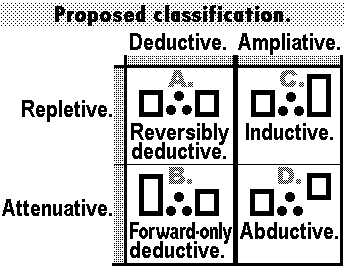
Modes of Inference
|
|
Note: In an old logic textbook you may find "strict deduction" defined as such that its premisses deductively imply, but are not deductively implied by, its conclusions. This was an application of the word "strict" as in "strict superset," "strict subset," etc. However, nowadays "strict deduction" is often taken to refer to deduction where the conclusions are relevant to the premisses in formally defined ways in a relevance logic. Hence the phrase "forward-only deduction" to refer to deduction whose premisses deductively imply, but are not deductively implied by, its conclusions.
Requisites for Beauty
| Aristotle order & due magnitude; order, symmetry, & limitation/ definiteness | Aquinas wholeness or perfection, integritas sive perfectio due proportion or harmony, debita proportio sive consonantia radiance, claritas | Tetrastic | |
![]() due force, due directional magnitude harmony, due proportion, due rhythm, consistency ![]() | ![]() radiance, vibrance wholeness, structural integrity, stability ![]() | ||
Elemental Modes of the Psyche
| Aristotle vegetative appetitive sensory-perceptual locomotor rational | Tetens feeling understanding will | Kant (a) cognitive faculties (b) feeling of pleasure or displeasure (c) faculty of desire (correlated with (a) understanding, (b) judgment, (c) reason) | Peirce
| Tetrastic | |||||||
1. will & conation2. dealing, handling | 3. affectivity4. cognition | ||||||||||
A little more on elemental modes of the psyche
Time ![]() | Will, Conation | Dealing, Handling | Affectivity | Cognition |
|---|---|---|---|---|
| For almost now: | Trying (out)/(for) | Testing, devising | Desire | Fancy, "impression" |
| For later | Seeking | Preparing, approach. | Hope, Confidence | Expectation, anticipation |
| For barely now | Taking, picking | Achieving | Pleasure, Satisf. | Noticing, discernment |
| For earlier | Adhering, habit | Maintaining, skill | Attachment | Memory |
From the inner mind to the outer limits
The times “almost now,” “later,” “barely now, just now,” and “earlier”, mentioned in the above tables, point to a generalization from the ubiquitous physical case of relativity’s light cone. Now, we say, roughly speaking, that one’s past affects one’s future but not vice versa. Should we likewise distinguish the present which one affects and the present which affects one? Aren’t they pretty much the same zone with respect to the somewhat prolonged present which a mind actually experiences? Yet they turn out to be worth our distinguishing as times far oftener than we do so. The initial point is:
• to recognize the philosophical generality of the idea of a finite general upper speed limit and the general import, for any system of communication and cause/effect, of finite general practical upper limits on the speed of signal propagation, though the given medium’s effective speed limit be less high and exact than some ultimate physical limit like lightspeed, and
• to recognize that mutually causal relationships involved with co-present objects don’t absolutely unite outgoing potency and incoming information, don’t render them indistinguishable in a wash of instantaneity -- don’t actually so unite them any more than they phenomenologically so unite them (as is more easily noticed from the viewpoints of the objects involved; compare with Merleau-Ponty’s idea of the never completed circuit between touching and being touched and even between touching oneself and being touched by oneself). Instead, two “presents” differ like future and past, differ as the respective edges, surfaces, of future and past. The difference runs deep -
| The difference runs deep | ||||
| b e t w e e n | the present (the almost present) toward which one acts and addresses oneself | a n d | the present (the just-now present) which acts upon one and is addressed to one | |
| that to which one is (almost now) present | that which is (just barely now) present to one | |||
| that for which one improvises (at least somewhat) | that which appears to one | |||
| outgoing best shots of not-yet-measured direct feasibility | incoming actual hits of not-yet-verified information | |||
A not insignificant further dimension of division of the psyche into elemental modes
I would also divide the psyche’s elementary modes along another dimension into those classes which in the case of cognition are (1) imagination, (2) conception & intellect, (3) the senses & cultivable ‘intuition’/‘instinct,’ and (4) commonsense perception.Promised discussion of beginnings, middles, ends, and checks/entelechies:
Archaí, beginnings, tryings, leadings, unsettlings. Mésa, middles, mediations, means, steadied going(s). Télê, teleiốseis, end(ing)s, culminations, unsteadied going(s) . Entelecheíai, entelechies, checks, settlings. |
In a Nutshell
Now, when we try, seek, pick or take, or adhere to something, sometimes it’s so direct that we don’t think of means as being saliently involved. But often enough there are intermediate stages through which we go, and intermediative things.• If the decision-making, the beginning, is regarded as a kind of main cause, those middles appear, relative to the situation of interest, as intermediate causes, helpers, facilitating causes. Of course they’re also intermediate effects. In any case we regard them as means.
• If the end is achieved, effected, sometimes it’s so directly obvious that we don’t think of any checks as being involved. But often enough there are collateral and at least a bit later things or events to which we look. If the end is regarded as a kind of main effect, those things or events “on the side” or further in time appear, relative to the situation of interest, as side effects, after-effects, evidentiary effects, checks.
Just as in advance one may have desired and hoped for the end, likewise one may have imagined and anticipated the collateral effects, the evidences, e.g., wakes, trails, tracks, shells, etc. One then also will have hoped for them, but only because one hopes for them as signs of the end’s having been achieved. They aren’t means to the end, they’re beyond and in addition to the end in a rather similar sense as the means are beyond and in addition to the beginning, the decision-making. And, just like an end, a check can be prospective, not yet accomplished.
We often think of an agent cause as compelling. That’s an affinity, not a rigid rule. One could also stand physically willing but not insistent for motion, and thus one will amount to a contributing agent cause of one’s motion if one does move. But let’s focus on the typical affinities among ideas. By pushing oneself, in the sense of pushing against the hardly movable ground for example, one compels one’s own motion, with a kind of physical insistence. On the other hand, we regard means as enabling rather than compelling. (The particular means may be necessary or, thanks to alternatives, unnecessary.) Now, let’s use this pattern of affinities in order to flesh out the conception of the “check,” the establishment or settlement or confirmation, as a cause. Given a goal, a prospective end or satisfaction, there is a necessity — not a compulsion but a kind of needfulness — for a means. Now, what conception stands to needfulness, as enablement stands to compulsion? A kind of reasonableness. Given that it will be established or practically knowable (at least by oneself if not by others, or even vice versa) and be a basis (for knowledge or whatever), one has reason to do something, that is, it’s reasonable to do it, in the sense that it will be real or solid or legitimate or in evidence. Why do it if it’s such that it might as well be unknown by anybody ever? Of course, sometimes one does something because it will be off the record or hidden or transitory or somehow not for real (and others will not know of it). But that is weak counter-example because the same kind of weak counter-example has always occurred in the case of goals: sometimes one does something because others will not care about it or even because it will block their aims. One note: just as an end or goal is not only about pleasure but first of all about the good — otherwise we might as well just attach electrodes to our brains' pleasure centers — likewise the check is not only about knowing and wakefulness, but first of all about the real, the legitimate, etc. To the problematics of goals, pleasures, pains, indifference, and of people acting against their own interests and ends, I come bearing reminders of the problematics of checks, knowledge, ignorance, deception, and of people acting as their own unwitting accomplices.
As a middle, a continuing, is like a staying-begun, so a check is like a staying-ended. There’s some nice simplicity and symmetry about these ideas, even as they incorporate asymmetry. We live in time-asymmetric world in which the check, the hold, the staying-ended (and, so to speak, its content) which follows upon a thing’s ending pertains to that thing more specifically, more informatively, than does a hold or holding-off which precedes the thing’s beginning. This and other asymmetries seem to have their part in the symmetries that abound.
Of course, just as a means can secondarily be an end and vice versa, so a check can secondarily be a means and vice versa, and likewise so can a check secondarily be a beginning, a decision point, etc.
Sidebar My conception of entelechy is somewhat nonstandard, based on ideas of stability and confirmation. I don’t seek mainly to clarify Aristotle. Unlike Aristotle and tradition, I don’t seek to stretch act and end to encompass form and entelechy. Such encompassment conflates the driven with the borne, the vibrant (or vigorous) with the firm, etc., and ramifies into conflating the driver (agent) with the bearer (patient). Systematic deeper equivalences aren’t found without recognizing the systematic distinctions nearer the surface.A traditional view of entelechy appears in the entry for “entelechy” in the great Century Dictionary. C.S. Peirce may have written the entry and probably at least reviewed it, since it is among the words at the relevant database at the Peirce Edition Project’s branch at the Université du Québec à Montréal (UQÀM) (Website at http://www.pep.uqam.ca/ ) From the Century Dictionary, Vol. III, Page 1946, Entastic to Enter (DjVu): entelechy (en-tel´e-ki), n. [ ‹ L. entelechia, ‹ Gr. ’εντελέχεια, actuality, ‹ ’εν τέλει ’έχειν, be complete (cf. ’εντελής, complete, full): ’εν, in; dat. of τέλος, end, completion; ’έχειν, have, hold, intr. be.] Realization: opposed to power or potentiality, and nearly the same as energy or act (actuality). The only difference is that entelechy implies a more perfect realization. The idea of entelechy is connected with that of form, the idea of power with that of matter. Thus, iron is potentially in its ore, which to be made iron must be worked; when this is done, the iron exists in entelechy. The development from being in posse or in germ to entelechy takes place, according to Aristotle, by means of a change, the imperfect action or energy, of which the perfected result is the entelechy. Entelechy is, however, either first or second. First entelechy is being in working order; second entelechy is being in action. The soul is said to be the first entelechy of the body, which seems to imply that it grows out of the body as its germ; but the idea more insisted upon is that man without the soul would be but a body, while the soul, once developed, is not lost when the man sleeps. Cudworth terms his plastic nature (which see, under nature) a first entelechy, and Leibnitz calls a monad an entelechy. To express this aspect of the mental functions, Aristotle makes use of the word entelechy. The word is one which explains itself. Frequently, it is true, Aristotle fails to draw any strict line of demarcation between entelechy and energy; but in theory, at least, the two are definitely separated from each other, and ’ενέργεια represents merely a stage on the path toward ’εντελέχεια. Entelechy in short is the realization which contains the end of a process: the complete expression of some function—the perfection of some phenomenon, the last stage in that process from potentiality to reality which we have already noticed. Soul then is not only the realization of the body; it is its perfect realization or full development. E. Wallace, Aristotle's Psychology, p. xlii. Joe Sachs in the “Energeia and Entelecheia” section of his article “Aristotle (384-322 BCE): Motion and its Place in Nature” in the Internet Encyclopedia of Philosophy is dissatisfied with the traditional emphases in interpretation of what Aristotle meant by entelécheia. Sachs writes: Entelecheia means continuing in a state of completeness, or being at an end which is of such a nature that it is only possible to be there by means of the continual expenditure of the effort required to stay there. Just as energeia extends to entelecheia because it is the activity which makes a thing what it is, entelecheia extends to energeia because it is the end or perfection which has being only in, through, and during activity. Yet, the activity and effort turn out sometimes, in Sachs’s descriptions, to be a stable static balance of forces, for instance as with an attracted stone at rest against the attractive earth under water. We normally would not say that such a stone is active or that such a stone’s position or behavior is a continual expenditure of effort. Instead we would note the effort that stands invested and the potential energy, potential activity, thereby involved. All the same — aside from Sachs’s initially making it sound as though a stable static equilibrium couldn’t be an entelechy — his conception of entelechy is closer than the traditional one is to my deliberately altered conception of it, given his emphasis on the staying complete, not to mention his depicting it in terms of places and embeddedness in the world. And I also don’t regard all entelechy as necessarily static. Maybe my version isn’t as nonstandard as I thought! |
End versus check: culmination versus standing finished
By ‘end,’ I mean a culmination, an ending — télos in the sense of ‘teleiosis,’ reaching the end, actualization. The check, on the other hand, is a kind of settlement, solidification, and holding in completeness — entelechy (see sidebar) —, be it ontic or epistemic.The check or entelechy amounts to a kind of confirmation of things which might have been illusory or transitory. In a broader sense than is usual for the word “entelechy,” one can consider wakes, tracks, trails, shells, husks, etc., as entelechies, or as outcroppings of an entelechy of the situation.
However, the traditional emphasis, in the conception expressed by the term “entelechy,” has been on the entelechy as a having COMPLETE (or a holding or being COMPLETE), fully and not just partly actualized — rather than on entelechy as a HAVING (or HOLDING or BEING) complete - a standing finished - in a settled completion that can stand up to trials. It’s been enTELechy instead of entelECHY. That traditional emphasis on fullness of actualization (rather than on solidity, establishment), going back to the term’s orginator Aristotle, has permillennially missed something of the confirmational aspect, I think.
Hard it is to become good, harder still to stay good — that sort of thought seems to have been at the root of it, so it’s good to remember that, in a practical sense, what’s involved in staying good is not only that one fully has the good, but also that one’s good is firm and can stand up to reality’s trials and tests, whether they come thick and fast, or otherwise. It’s a good which is tried and true.
Moreover, it is simpler to regard entelechy in that way, as being a distinct principle, something further than a being-fully-completed, since one already regards the middle as being something further than a being-fully-begun. The analogy is exact down through its foundations, as will be seen in a moment. One must be regardful of the systematic conceptual structure of stayings and becomings which undergird these ideas.
Which brings us to the following:
Occam Doesn’t Raze Exactly One Corner of the Square of Opposition
One might object that “beginning, middle, end” seems so nice and complete; why add something more? Beginning, middle, end, like start, continue, stop.
Logically, however, it doesn’t seem so nice and complete at all. Instead:
Beginning, like starting at time t
— X occurs? no (for some period) till t, yes (for some period) since t.
Middle, like continuing at time t
— X occurs? yes (for some period) till t, yes (for some period) since t.
End, like stopping at time t
— X occurs? yes(for some period) till t, no (for some period) since t.
Check, like refraining, holding at time t
— X occurs? no (for some period) till t, no (for some period) since t.
Now that’s logically nice, complete, and hardly escapable, exhausting the combinatorial possibilities of the two relevant parameters.
The entelechy is traditionally associated with the form. Now, a structure is an equilibrium (be the equilibrium static, harmonic, or whatever else) among forces with some stability. Therefore the structure of a thing - even with all the mobility, flexibility, etc., which the structure may have - is a settlement or establishment of the thing, and is the kind of form (as opposed to form as aspect, figure, quality, etc.) most suited to be regarded as the entelechy. While the good has the rational character of an end, a culmination, on the other hand the true, the sound, the legitimate, have the rational character of a check, an entelechy.
It is also possible to make an entelechy the end, goal, culmination of one's action, as when one acts in order to prove something - maybe in inquiry, but also, for instance, about oneself in daily life, acting to prove oneself as being legitimately this or that, deserving of some sort of recognition or honor or accorded status, or to prove that some people do or don't deserve some status. (How many times, in practical matters, have you heard one person ask another, "what are you trying to prove?")
One can make a goal of any of the four causes, and there are 'arenas' of contention for them -
For instance one makes a goal of a beginning, a deciding, a leadership, when one vies or contends in group or mass decision-making for a decision or for a way of decision-making (politics, military battle, etc., deciding who or what gets to decide, etc.).
If it's a vying to have or be means in general, then it's for wealth, wherewithal, (e.g., business, commerce, finance, etc.) .
If it's a vying to have or be ends in general, a vying to be valued, then it's for glamour, glory, wattage, splendor (e.g., fashion, sports, popularity, notoriety, opulence, "hipness," etc.).
If it's a vying to have or be entelechies in general, a vying to be legitimized, then it's for honor, standing, etc. (e.g., case-building, discussion, debate, the formation of common opinion).
Agent, patient, act, borneness
1. Beginning, impetus. Agent cause, mechanism, etc. & Agency, operation. Mover, affector, agent. Source of change or rest. Compare versus net momentum, impulse, force. 2. Middle, means, development. Material, composition. & Bearing, coping. Bearer, endurer. Mediation of change or rest. Compare versus rest mass, rest energy, internal work & power. | 3. End(ing), teleiosis, culmination. Actualization, differentiation, etc. & Act, action, activity. Moved, affected, acted-on. Culmination of change or rest. Compare versus (non-rest) energy, work, power. 4. Check, entelechy, establishment. Structure. & Borneness, balancement. Borne, endured. Settlement/resolution of change or rest. Compare versus internally balanced momenta (potential & kinetic), impulses, forces. |
| Note: Momentum, force, etc., do not "cause" energy, work, power, as "effects." Instead the quantities were originally conceived of in the attempt to quantify "causativeness" and effect. | |
The agent acts on the bearer a.k.a. patient, e.g., matter, and, to the extent that the bearer suffers through to a completed change, that completed change is the act. Agent-patient-act: the ancient philosophical tradition.
(In the case of "rest" or stasis imposed by the agency, I'm not aware that Aristotle discussed "completed" stasis or the like, but suitable ideas seem to include that of a stasis culminating in some event and that of a stasis with the potential energy of the event in which it would culminate.)
Inching beyond ancient tradition.
The act is an affectedness, an acted-on-ness, of the bearer (except in the extreme case of a creation out of nothing). A bearer is affectable, but it is not always vigorously, distinctively affected; I mean that bearing and being affected aren’t to be crudely conflated, as when we think of bearing only as suffering rather than as, first of all, patience. Indeed we don’t conflate them when we think of the bearer as matter, process, etc., and of the affectedness, the act, as energy, culmination, etc. There is an equivalence between bearing and being affected, yet also distinctions between them along lines of potency vs. act, and of inside vs. outside. The perspective of inside-outside relations also arises in one’s seeing an inside as a “mini-outside.” Internal act, internal vigor, help constitute the temper, harmony, patience of a whole.Breaking with ancient tradition.
What’s sauce for the goose is sauce for the gander. If bearer per se is to be distinguished from bearer as affected, and if bearer’s patience and endurance are to be distinguished from bearer’s affectedness (the act), then, correspondingly, agent per se is to be distinguished from agent as borne, and agency as affecting is to be distinguished from borneness, borneness manifested in the extents and ways in which agency is itself turned, opposed, balanced, stabilized, etc. However, neither Aristotle nor the Scholastics considered form first of all in terms of movements or forces balanced within a system, though this equilibrium is, if stable and basic to the system, the system’s structure (in its aspects kinetic & static) and, otherwise, a kind of state of the system. Instead Aristotle & the Scholastics emphasized more abstract and pliable conceptions of form and classed the form, along with the end, as act. So tradition passed along three principles — agent, patient, act — yet four causes — efficient, material, final, and formal.
We come to a fork in the road as to the meaning of the ancient Latin verb pati, “to bear,” “suffer,” etc. — (1) “to endure, to bear up under,” and (2) “to undergo, to yield up to.” (The ancient Greek paschein had pretty much the second meaning.) A thing may to various extents both endure and yield. The first sense is primary for pati and may be associated with not only endurance but also spiritlessness, a kind of inertia; the second sense is tied to the idea of act, the driven, which, in a sense, is opposite to the patient, its patience, the enduring; the two opposed ideas are of aspects of duration, ideas, respectively, of temperate versus vigorous, and, respectively, of enduring versus briefening. As the ideas of patience and act are temporal, so the ideas of agency and, opposed to it, borneness, are spatial ideas, involving magnitudes with directionality and directional opposability. The agent is an impetus for process, development, becoming, eventuating in act. The old tradition defined ongoing change, shift, spatial or otherwise, which it called “motion,” as the state of being between potency and act. But underlying an agency is an even simpler role of mover, impeller, imparter of spatial motion which is not itself a process culminating, by its own incubative nature, in act. Spatial motion and rest (stationariness) are relative; and simple uniform motion is a changing of distance-defined relative location, which continues indefinitely if not interrupted. This is travel, not duration, and pertains most directly to an agent’s driving and impress, rather than to a patient’s enduring and incubating. (The traditional idea can be saved to a small extent: potency: a thing is at rest in its own reference frame; motion: then it gets hit and now travels or is at rest in a changed reference frame; act: finally it collides with something.)A wrench in the works is that the word “passion” succumbed fully to the second sense of pati, the sense of “to undergo, to yield up to.” The act (or action qua act, as distinguished from action qua operation, impelling, driving) which is the acted-on-ness is, by that very stroke, the “passion” of the patient, and differs only in its perspective; the passion is the act as regarded from the receiving end, while the act is said as a deed to be of the agent, though the word “act” comes from a passive participle meaning “been made or driven.”
Anyway, this semantic choice about the word “passion,” the traditional one, obscures the more meaningful distinction outlined above between the act and the borneness, one whereby the end can be distinguished from the form at the level of causes' principles, as act and borneness.
The patient hardly exists as a patient except so long as the balance, supportedness, stability of agencies in its system — the agencies which the patient contains or has internalized — are there in some significant measure. If instead the patient yields up fully and thoroughly, it will be converted to pure act, like matter into kinetic energy. A patient may yield (pati in the second sense) fully to an agent, but basically a patient is an endurer (pati in the first sense), and a borneness is an agent’s corresponding balancement. Now, that is to make borneness sound like balanced internal agencies. Far from objectionable, that is desirable, (a) since the idea of balanced internal agencies obviously pertains to the idea of structure and therefore of the formal cause, which thereby at last has a distinct causal principle in borneness, and also (b) since nothing is wrong and something is right with agency and borneness being in some sort of equivalence, when patience and act are in some sort of equivalence. The bearer (or its patience) is in a sense internal act, internally stored, tempered act, internal vigor, in latent and patent modes, which comprises the temper and patience of a whole. For instance, rest mass (correlated to proper time, “own duration”) is equivalent to rest energy (though in order for this analogy to work in terms of the primitive terminology of “agent, bearer, acted-on, borne,” one must, among other things, consider momentum as impulse which is a suitably more “agential” idea than that of momentum per se).
The resultant tetrachotomy is a kind of square of oppositions of causes’ principles, with an axis of space along the downward diagonal, and an axis of time along the upward diagonal.
agency ~ ~ act
~ ~ ~ ~ X ~ ~ ~ ~
bearing ~ borneness
Moreover it’s worth noting that, logically, insofar as agent & patient are like “maker” and “allower/supporter,” their conceptions are subject to logical inter-transformability like their kindred conceptions necessity and possibility in simple parallel.
Why it is, that agent and patient should both of them be principles of change yet their passive-voiced versions should not, likewise unconflated, both of them be principles of change, is a question which has unfortunately gone largely unnoticed, so far as I know. It’s especially unfortunate insofar as it seems that, for the various already noted reasons, the borneness is just as valid a principle as agent, bearer, and act. Occam’s Razor isn’t blind and won’t cut here; to the contrary, if agent is the driver and act the driven, and if bearer is endurer, then borne is the endured, not the driven. The value of the simplicity of consistency should have led reasoning along this road long ago.
The agency is an initiation of change or rest (or arrest), the patience is a mediation of change or rest, the act is a culmination of change or rest, and the borneness is a settlement or resolution of change or rest. Thus those four terms reassuringly parallel the gamut of logical possibilities of change’s starting, continuing, stopping, refraining.
Note: It is not necessarily that there are always two things, agent and bearer, in various roles; one same thing may be agent and bearer; and the acted-on in question may be or become separate from the bearer in question; some of an agent’s agency may be internalized by the bearer and become stably balanced within it, in a restructuring; and so forth.
Human Versions of the Four Principles of the Four Causes
Again, agency is an initiation of change or rest. Human agency is will, volition, conation. Bearing or patiency is a mediation of change or rest. Human bearing, mediating, is ability, handling, dealing-with. Act is a culmination of change or rest. Human acted-on-ness, humanly being-affected, is affectivity. Borneness is a settlement or resolution of change or rest. Humanly being upheld, supported, is cognition. (Note: I don’t mean that cognition is something inherently frozen! Quite to the contrary.)1. Agency ―――› will & character. ~ ~ ~ ~ 3. Acted-on-ness ―› affectivity & sensibility.
2. Bearership ―› dealing & competence. ~ 4. Borneness ―――› cognition & intelligence.
On a level where one distinguishes between will and affectivity, one should make also the same distinction between dealing (trectation, dealing-with) and cognition. It’s like the distinction between efferent (as with efferent nerves carrying signals out from the brain to the muscles) and afferent (as with afferent nerves carrying signals to the brain from sensory receptors).
Similarly, on a level where one distinguishes either (1) dealing-with from will or (2) cognition from affectivity, on that level one should make both distinctions. Between members of each pair there is a difference like that between the indirect (e.g., finesse) and the direct (e.g., force), or between that which is stabilized or steadied within a system and that which is otherwise in its involvement with the system.
Teleology as Philosophical Botany
Forces, decision processes, complex dependences on beginnings, leadings, tryings, unsettlings. Matter, stochastic processes, complex dependences on middles, mediations, means, steadied going(s). Life, informational/cybernetic processes, complex dependences on end(ing)s, culminations, unsteadied going(s). Intelligence, inference processes, complex dependences on entelechies, checks, settlings. |
Multiplicities of Functions and Statuses
Agency, operation. (Aristotelian category: ACTION.) Capacity, caliber. Power (force, influence), might. Beginnings, leadings, tryings. Manner, mode, bearingship. (Aristotelian category: POSITION, ATTITUDE, APTNESS.) Ways-&-means. Wealth, affluence. Middles, mediations, means. Acted-on-ness, passion. (Aristotelian category: PASSION.) Role, function. Glory, wattage, glamour, “action.” End(ing)s, culminations. Condition, state, borneness. (Aristotelian category: STATE, HAVING.) Status. Honor, standing, basis. Entelechies, checks. |
Another discussion: "Mining Aristotle's Four Causes for order & balance."
Classifications of Research
Caveat: Birger Hjørland has written: “There is not today (2005), to my knowledge, any organized research program about the classification of the sciences in any discipline or in any country. As Miksa (1998) writes, the interest for this question largely died in the beginning of the 20th century.”| C.S. Peirce's classification of research This is based mostly on his 1903 classification of the sciences in CP1.180-202. At its start in CP1.180, Peirce says: "This classification, which aims to base itself on the principal affinities of the objects classified, is concerned not with all possible sciences, nor with so many branches of knowledge, but with sciences in their present condition, as so many businesses of groups of living men. It borrows its idea from Comte's classification; namely, the idea that one science depends upon another for fundamental principles, but does not furnish such principles to that other. It turns out that in most cases the divisions are trichotomic; the First of the three members relating to universal elements or laws, the Second arranging classes of forms and seeking to bring them under universal laws, the Third going into the utmost detail, describing individual phenomena and endeavoring to explain them. But not all the divisions are of this character." Some online Peirce classifications of the sciences: CP1.180-202 (1903) http://www.princeton.edu/~batke/peirce/cl_o_sci_03.htm CP1.180-202 (1903) & 1.203-283 (1902) http://www.textlog.de/4257.html MS L75 (1902) http://www.cspeirce.com/menu/library/bycsp/l75/ver1/l75v1-02.htm "Development of Peirce's classification of sciences - three stages: 1889, 1898, 1903" (pdf) Tommi Vehkavaara (2003) http://www.uta.fi/~attove/peirce_syst.PDF "The outline of Peirce's classification of sciences (1902-1911)" pdf) Tommi Vehkavaara (2001) http://www.uta.fi/~attove/peirce_systems3.PDF Vehkavaara in "Development of Peirce's classification of sciences - three stages: 1889, 1898, 1903" (pdf) (2003) points out that Peirce's first published such classification may be an 1889 version found in the Century Dictionary under "Science" definition c., p. 5397. Now, "Science" is among the words in the database at the Peirce Edition Project on Peirce's contributions to the Century Dictionary at UQÀM (Université du Québec à Montréal). If Peirce indeed wrote the Century Dictionary's definition of "Science," then it's significant that maths there are divided into "pure" and "applied," and that the latter consist of (1) "mathematical philosophy" (including probability theory, which Peirce omits from later classifications), (2) "mathematical physics," and (3) "mathematical psychics" (including economics). (1) NOMOLOGICAL, (2) CLASSIFICATORY, (3) DESCRIPTIVE: One sees the spirit of Peirce's nomological - classificatory - descriptive trichotomy in much of his classification. He strongly seems to be describing it in the above-quoted remark at the start of his 1903 Syllabus classification. However he uses the terms "nomological," "classificatory," and "descriptive" as labels for divisions in only the special (a.k.a. idioscopic) sciences. Possibly, for instance, Peirce did not outright call mathematics nomological because the word (like "nomothetic") refers to law-formulative tendencies in only the special sciences. The Century Dictionary does not so limit the relevant sense, but the somewhat later Oxford English Dictionary on the relevant sense of "nomological" says: "Relating to or denoting certain principles, such as laws of nature, that are neither logically necessary nor theoretically explicable, but are simply taken as true." (1) UNIVERSAL ELEMENTS OR LAWS, (2) CLASSES, (3) DESCRIPTIONS: In CP1.180 at the start of his 1903 classification, Peirce says (see quote above) that most of his classifications of sciences (which include mathematics by his terminology) turn out to be "trichotomic," each trichotomy with its "First," its "Second," and its "Third." By such language and capitalizations Peirce usually implies correlations to his categories firstness (quality of feeling), secondness (reaction, resistance), & thirdness (representation) (tintings mine). On the other hand, if Peirce had felt sure of the correlations in the case of his science classifications, he would not have been shy about more plainly outlining them in some article. My tintings of his science classifications further below are in order to bring into visual relief Peirce's trichotomical science-classificational pattern of scientific aims at (1) universal elements or laws, (2) classes, (3) descriptions and also the possible correlations to 1stness, 2ndness, 3rdness, respectively. Now, arguably the explicit nomological - classificatory - descriptive subdivisions in the special sciences (a.k.a. idioscopy) match pretty well his account of his typical classificational trichotomy, and echo the big division into math - philosophy - special sciences and also the bigger division into discovery science - review science (a.k.a. synthetic philosophy) - practical science. The tintings of Peirce's divisions there and elsewhere are based on my reading of Peirce & my general sense about it. There are quandaries. For instance, the continuous & the singulars (things which can be at only one place per time) in their concrete multiplicity are classed in some cases alike as the business of descriptive (3 or C or iii, etc.) sections, though continuity is a 'third' and the singular is a 'second.' | Tetrastic classification of research This is displayed (further down) in that which is traditionally called the order of being, the order of that which is more basic ontologically and, in this discussion, the order of research fields about things (laws, entities, etc.) by appeal to which we explain things. The reverse order is traditionally called the order of knowledge, the order starting from the best known and most familiar and, in this discussion, is the order of research fields about things by appeal to which we establish, confirm, corroborate things. The order of being has been favored for orderings within the special sciences. The order of knowledge has been favored for orderings within mathematics. The orders are compatible at least to the extent that they're but systematic transformations of one another with correspondingly related criteria. (A combinatorial feeling suggests that there may be two other significant orders, too.) All the fields mentioned, including "inverse optimization theory," are actual disciplines, though inverse optimization theory is especially young, perhaps 11 or 12 years old, as a discipline. The divisions are all tetrachotomical, though if I went into the level of subclassification which Peirce does, I would make quite non-tetrachotomical classifications as well. One expects such a logical pattern at some point to yield diminishing returns and eventually to become counterproductive. The first of the four members relates to universal balancements, laws, rules, the universal which is not itself a universe but instead applies beyond the given instance. The second relates to totalities, completive divisions, and gamuts of elements and of combinations. The third relates to assortings by distinctive accordances. The fourth relates to unitary items monadic and in polyads (in a larger population or universe) and their unique pairings and orderings, partial orderings, etc. Now, in order to put the special sciences collectively first in order of knowledge before more abstract studies which they come to apply, one will need to take "knowledge" in a sense including that of "familiarity" and this is an especially disputable point; but there are patterns clear enough to leave a considerable residuum after any such disputation. The systematic inter-transformability of orderings would mean that one can pursue essentially the same classification questions irregardlessly of variations of views about what's more basic, the order of knowledge or the order of being?, and even irregardlessly of variations of views about the ontological status of mathematical objects, laws, etc. You may wish to call the order of being "the order of abstractness" or something like that; but whatever you call it, we'll be able to agree that you mean the opposite of the order of knowledge/familiarity. A little more detail on how the order of knowledge reverses the order of being in the special sciences. We establish (and verify, (dis)confirm, etc.) evaluations and interpretations. We evaluate and interpret measurements and other signs and representations. We measure and form representations of things objectified by location, connection, etc. 1. Of course, in order to verify anything in the concrete world, one needs to know about (and be a part of) concrete people doing that. That is human and social knowledge. 2. In order to evaluate, interpret, things in the concrete world, as distinctive or redundant and as, for instance, making a possibly dangerous difference to the experimenter, one needs to know about (and be a part of) life and information; life is sophisticated information processes made flesh, and is unique in its capacity to depend on differences which make hardly any difference on a strictly material level. 3. In order to measure things in the concrete world, one needs to know about (and be part of) matter and its interactions. 4. In order to locate things and identify connections in the concrete world, one needs to know about (and be a part of) motion, forces, space, time, etc. (But again, all these things need measurement, evaluation, and verification, and, remember, we’re talking order of knowledge here). Special relativity, concerned with inertia, momentum, etc., is considered very general and basic and is based on ideas about uniform motion. Yet inertial forces do not appear under circumstances of strictly uniform motion and there would be no occasion to form a conception of inertia. So it can be seen that in a general way the order of being and the order of knowledge are each other's reverse. There isn t a compelling need to fix upon one as being more basic; the compelling need is to specify the senses in which one means words like “foundational” and “basic.” Tetrastic categorial correlations:
| ||||||||||||||||||||||||||||||||||||||||||||||||||||||||||||||||||||||||||||||||||||
So, how to reconcile?: Peirce's scientific approaches trichotomy of (1st) Universal elements or laws, (2nd) Classes, (3rd) Descriptions with his 1stness-2ndness-3rdness-based trichotomy of (1st) Chance, (2nd) Law, (3rd) Habit-taking, which itself has to be reconciled with his 1stness-2ndness-3rdness-based trichotomy of (1st) Possibility, (2nd) Actuality, (3rd) [Conditional] Necessity. Peirce noted a movement of fields from description, into classification, and finally into dealing with universal elements or laws. Said movement reflects the 1-3-2 movement from (1st) chance through (3rd) habit-taking to (2nd) law -- with chance and law as habit-taking's two already encountered limits. Its reverse (2nd) law, (3rd) habit-taking, (1st) chance, (starting from the goal which is law) seems the ordering principle for his classification of the sciences. However, such classifications as (A) Phenomenology, (B) Normative science, & (C) Metaphysics, seem, as those fields study (A) appearances, (B) norms, & (C) commonly regardable special or almost-special cases, to follow a 1-3-2 possibility - necessity - actuality order or a 1-2-3 chance - laws - habit-taking order better than a 2-3-1 order, while simultaneously adhering to the science trichotomy of (1st) universal elements or laws, (2nd) classes, (3rd) descriptions. Peirce seems to keep the door open between his science trichotomy and others through the idea of appearance and chance as universal elements or laws, and some idea of nature's laws as somewhat arbitrary, even a form of chance, the sense which "nomological" included or came to include. Last exit to Peircean tri-categorialism (in my view). Distinctions such as those among subject matter, method, and objective and between evolution and involution might offer a solution. Gary Richmond discusses the idea of various orderings or "vectors" in "Trikonic Analysis-synthesis and Critical Common Sense on the Web" (2006) at http://www.cspeirce.com/menu/library/aboutcsp/richmond/ccsarisbe.pdf. Richmond, who teaches communications, is alert like other Peircean philosophers to apparent conflicts in the application of Peirce's categories but seems almost unique in actively seeking to do something systematic, within a decidedly Peircean framework, about such conflicts. His orderings or vectors build on some ideas of Peirce's own, and would, even without the spur toward resolving the apparent conflicts, address the need for a systematic Peircean trichotomization (or hexachotomization) of traditional ideas like those of the order of being and the order of knowledge. versus (1) UNIVERSALITIES, (2) TOTALITIES, (3) KINDS, (4) UNITARY THINGS: Peirce's basic error, in my view, in his typical research-classificational trichotomy ((1) universal elements or laws - (2) classes - (3) descriptions) is his conflation of two disparate, essentially mutually inverse approaches into the "classificatory" - (A) that which analyzes into basic constituents from a complete gamut or totality of alternatives, and explores combinations of constituents (as in the case of chemical elements & substances) and their properties which often differ from those of their constituents; and (B) that which differentiates and, finding or putting like with like, assorts (as in the case of biological parts and wholes of organisms, and species, genera, etc.) into increasingly broad kinds; -- the two approaches working their mazes, so to speak, from opposite ends. Of course these are simplifications as regards chemistry and biology, but true enough in their rough way. The Completive-vs.-Assortative difference comes into nontrivial relief between various fields such as matter science and biology (though of course every field has its shares of both these approaches). Instead of Peirce's trichotomy of (1) universal elements or laws - (2) classes - (3) descriptions, I find in my system that there are focuses on: 1. Universalities; 2. Totalities, full complements, exhaustive divisions; 3. Species, genera, assortings; 4. Unitary things and unique orderings. — "Universality." The idea here is not simply that of "All F is G" but is instead that of the non-exhaustive universal in the sense, for instance, of "3," "500," etc., such that anything whatsoever will be one of three in a larger universe, one of five hundred in a larger universe, etc., and "3" will be any several, distinct xyz collectively whatsoever in a larger universe. It's a universal with further applications than the given one, or, at any rate, a universal with more than one application. Such is what people usually actually mean by "universal." It needs and deserves a distinct name but there is none. Anyway, the spirit is that of the so-called "miraculous jar" of positive integers and of ever more things (or at least mathematical objects) for them to be true of or applicable to. ![]() — "Totality." My point is the exhaustiveness, the completiveness of divisions. (I don't have anything like Gödelian completeness in mind.) It's the exhaustive, the universe of discourse, the totality, the gamut (e.g., cdefgab in the universe of a plinker's notes), gamuts of theoretically possible combinations, etc. This is a logical quantity at the same level of analysis as the "universal with applications beyond the given instance." — "Assortings." Such characterizes one's putting of like with like even before one has established a system of classes. The logical quantity is the special (in the sense of non-universal) combined with the general (in the sense of non-singular), as for instance "red" which is neither universal to things nor singular. — I alight upon the ideas of "unicity" instead of "descriptive" or "explanatory" in order to evoke sufficient generality for this mode. The idea, in terms of logical quantity, is of the non-exhaustive monadic singular or singulars in polyad (non-exhaustive, i.e., the thing or things in question are in among more things, a larger universe, embedded in a world, instead of constituting a universe by themselves). Such is what people usually have in mind in thinking of things denoted by singular terms. (This, like each of three other logical quantities outlined above, is a conjunctive compound of simpler quantities, and together the four compounds constitute a set exhaustive of the combinatorial possibilities at their level of analysis.) The fields which, in comparison to their kin, are called descriptive, are ironically underdescribed thereby, and are often also instantiative, even consolidative, rife with multiple applications from other fields, and in fact involve anchorings, connectings, orderings, into tapestries of variegation, explanation, and (dis)verification, in which unitary things are uniquely paired, trio'ed, etc. The anchorings, linkings, orderings, hierarchizations, are themselves suitable for abstraction and general study; I call such abstract studies unicitative even when they are not descriptive. "
| |||||||||||||||||||||||||||||||||||||||||||||||||||||||||||||||||||||||||||||||||||||
| A. Science of Discovery. B. Science of Review. C. Practical Science. Peirce about Science of Review - "arranging the results of discovery, beginning with digests, and going on to endeavor to form a philosophy of science. Such is the nature of Humboldt's Cosmos, of Comte's Philosophie positive, and of Spencer's Synthetic Philosophy. The classification of the sciences belongs to this department." Previously, in his 1902 application to the Carnegie Institution (MS L75.355), Peirce had divided science thusly: A. Theoretical Science. I. Science of Research. II. Science of Review, or Synthetic Philosophy. B. Practical Science, or the Arts. | A. Mathematical & scientific researches. B. Affective arts (lit., music, visual, etc.).C. Productive arts/sciences ("know-how"). D. Ruling/governing arts. Important: The ordering of the fields shown just above is the opposite of their ordering as disciplines. Broader picture (for details, click here)
| ||||||||||||||||||||||||||||||||||||||||||||||||||||||||||||||||||||||||||||||||||||
| Pattern to which Peirce's classifications of sciences tend to approximate: 1. Universal elements or laws; 2. Classes; 3. Descriptions. | Pattern of tetrastic classifications of sciences: 1. Factors, rules, constrainings, equilibrations 2. Elements, totalities, combinations, apportionments; 3. Particulars, differentiations, assortings; 4. Items, etc., orderings, hierarchies. | ||||||||||||||||||||||||||||||||||||||||||||||||||||||||||||||||||||||||||||||||||||
| FROM PEIRCE'S CLASSIFICATION OF SCIENCES OF DISCOVERY. | TETRASTIC CLASSIFICATION OF RESEARCH FIELDS. I don't try to show fields which arise as combinations of other fields. | ||||||||||||||||||||||||||||||||||||||||||||||||||||||||||||||||||||||||||||||||||||
| I. 'Pure' mathematics - Tends to draw equivalential conclusions. About universals that aren't universes. Four subdivisions seem to traverse A., B., C., D. below: 1. sets (e.g. of curves) > the continuum; 2. continuous & uncountable (e.g., reals);3. discrete & everywhere dense (e.g., rationals); 4. discrete & not dense. (Functionals range over curves and belong in 1.) | ||||||||||||||||||||||||||||||||||||||||||||||||||||||||||||||||||||||||||||||||||||
| A. (Many-to-many) equations, extremization, topology, graph theory. | B. (One-to-many) integration, measure, enumerative combinatorics. | C. (Many-to-one) functionals, functions, their derivatives. Algebra. | D. (One-to-one) limits, ORDER, conditions affecting math-induction applicability. | ||||||||||||||||||||||||||||||||||||||||||||||||||||||||||||||||||||||||||||||||||
| II. 'Applied' yet mathematically deep/nontrivial mathematics Tends to draw non-reversibly deductive conclusions. About totalities, universes. | |||||||||||||||||||||||||||||||||||||||||||||||||||||||||||||||||||||||||||||||||||||
| A. Deductive math theory of optimization. | B. Deductive math theory of probability. | C. Deductive math theory of information (w/ historical overlap of research interest into abstract algebra). | D. Deductive math theory of logic. | ||||||||||||||||||||||||||||||||||||||||||||||||||||||||||||||||||||||||||||||||||
| III. Abstract yet positive-phenomenally deep/nontrivial studies (cenoscopy) - Tend to draw ampliatively inductive conclusions. About the non-universal general = the non-singular special. | ||||||||||||||||||||||||||||||||||||||||||||||||||||||||||||||||||||||||||||||||||||
| A. Inverse & multi-objective optimization (descriptive & inductive phases) & its mathematical formalisms. | B. Statistics. | C. Communication / info theory (descriptive, inductive) & its mathematical formalisms. | D. Philosophy | ||||||||||||||||||||||||||||||||||||||||||||||||||||||||||||||||||||||||||||||||||
| IV. Special sciences (idioscopy) - Tends to conclude in surmises to laws, entities, etc. About singulars among more singulars (and seeking to learn their laws, elements, kinds, uniquenesses). | ||||||||||||||||||||||||||||||||||||||||||||||||||||||||||||||||||||||||||||||||||||
| A. Sciences of motion, forces. | B. Sciences of matter. | C. Sciences of life. | D. Sciences of mind, intelligence, intelligent life. | ||||||||||||||||||||||||||||||||||||||||||||||||||||||||||||||||||||||||||||||||||
| * Peirce's "Minute Logic" (1902) includes discussion of Epistêmy and Theôrics, and says (CP1.278 http://www.textlog.de/4260-2.html) : "...[theôrics] only resort to special observation to settle some minute details, concerning which the testimony of general experience is possibly insufficient." There's no mention of 'necessary philosophy,' 'Epistêmy,' or 'Theôrics' in the 1903 Syllabus outline classification in CP1.180-202 http://www.princeton.edu/~batke/peirce/cl_o_sci_03.htm . ¹ Speculative Grammar includes the classification of signs. ² Critic includes the study of the modes of inference (especially the deductive, inductive, & abductive modes). ³ Methodeutic, also called 'Rhetoric' by Peirce, seems the locus of the Pragmatic Maxim and anyway includes the study of scientific method. ** Peirce in the 1903 Syllabus classification: "Classificatory physics seems, at present, as a matter of fact, to be divided, quite irrationally and most unequally, into i, Crystallography; ii, Chemistry; iii, Biology." | |||||||||||||||||||||||||||||||||||||||||||||||||||||||||||||||||||||||||||||||||||||
First posted on Thursday, August 24, 2006—
Semiotic triad versus tetrad.
(Recentest significant change: April 5, 2007)
"Its Interpretant is all that the Sign conveys: acquaintance with its Object must be gained by collateral experience."
End quote.
Quote C.S. Peirce: Collected Papers of Charles Sanders Peirce volume 8, paragraph 179 (1909) (also in The Essential Peirce volume 2, pages 493-4):
"All that part of the understanding of the Sign which the Interpreting Mind has needed collateral observation for is outside the Interpretant. .... It is...the prerequisite for getting any idea signified by the sign."
End quote.
Quote C.S. Peirce, Collected Papers of Charles Sanders Peirce volume 8, paragraph 314 (March 14, 1909):
"We must distinguish between the Immediate Object, -- i.e. the Object as represented in the sign, -- and the Real (no, because perhaps the Object is altogether fictive, I must choose a different term, therefore), say rather the Dynamical Object, which, from the nature of things, the Sign cannot express, which it can only indicate and leave the interpreter to find out by collateral experience. For instance, I point my finger to what I mean, but I can't make my companion know what I mean, if he can't see it, or if seeing it, it does not, to his mind, separate itself from the surrounding objects in the field of vision."
End Quote.
Therefore, if something X, logically determined (determined in Peirce' sense, "specialized, bestimmt") through complex logical relationships leading from a triad, amounts to a recognizant, then it doesn't amount to a sign or an interpretant. If it were shown that those logical relationships, for their own part, consisted of nothing but relationships among object, sign, & interpretant, then such showing would amount either
(A) to a showing that triadism fails, for it would have shown that something was logically determined but not logically determined as sign or interpretant, or
(B) to a contradiction, since a relationship of being interpreted would have led to something which can't be an interpretant, and this would be to say that either the analysis was flawed or that the idea of a recognizant had been reduced to absurdity; yet if the idea of experience of object, sign, and interpretant in respect of one another is granted as non-absurd, then what has been shown is that a diagramming of logical relations in terms solely of object, sign, and interpretant is inadequate and can seem to be accomplished only by concealing a contradiction. Basically, either there is experience of object, sign, and interpretant in respect of one another, or there isn't. The rest depends on that.
So it is not a matter of showing that the recognizant can't be boiled down to an interpretant through appeal to very complex relations; instead it is a matter of showing that a recognizant can be formed at all, formed as logically determined by object, sign, and interpretant, and logically determining (quite powerfully) semiosis going forward. This is to say, it is a matter of showing that a mind can form an experience -- a reasonably direct (not reasonably immediate) experience -- of object, sign, and interpretant, respectively as object, sign, and interpretant in respect of one another, such that the experience is logically determined by the semiosis, and this in turn is just to say that a true representation of the experience's content as experienced, will be also a reasonably firm representation of the semiosis, to the extent that the experience suffices to reasonably settle doubt. Now, to deny the aforesaid formability and logical determination of such recognizant is to deny that one can have a reasonably direct and reasonably doubt-settling experience of semiosis. Therefore the price which Peirceans must pay in order to say that there is no recognizant (as a distinct basic semiotic element) is the embracing of the view that semiosis cannot be so embodied as to be experienced as semiosis, experienced with reasonable directness and so as to reasonably settle a doubt about it. The price is also the refusal to embody Peirce's experimentalist view of inquiry in the structure of basic semiotic elements, even though semiosis is inquiry process since it is inference process and is aimed at the reasonable settling of doubt.
Since the recognition, unlike the interpretant, is formed as that which reasonably settles doubt in some respect and yet it is fallible, it is in the bigger picture just a fallible form of that semiosic final stage which not only is logically determined, but also on which the real depends, and which would be a final recognition. The recognition is fallibly that which is depended-on in some respect by the real. Something X (the object) determines Y (the sign) to determine Z (the interpretant) (1) to stand in the same relation to X in which Y itself stands to X, and (2) to determine W (the recognizant) to stand to Y and Z in the same relationship in which X (the object) stands to Y & Z (though obviously not actually in the same "chronology-of-semiosis" relationship). The relationship "(2)" is the interpretant's formation as an appeal to a recognitive experience, a recognition, of object, sign, and interpretant in respect of one another. As the interpretant is a further sign interpretive of sign & representative of object, so the recognition is a further object formed as a mind's experiential subjection to the object, sign, and interpretant. Well, maybe I'll eventually find myself forced to back down from this radical claim of mine (which I posted on the same day that I first thought of it, 8/24-early25/06) that the recognizant is determined by object, sign, and interpretant, to stand in the same relation as the relation in which the object stands to the sign and interpretant. More modest and scaled-back is the claim which I've already been making in various forms, that the recognizant is determined to stand in the same relation (as the object does) to the further ongoing semiosis proceeding from the recognizant.
It's because the recognizant is that which reasonably settles doubt and suspicion in some respect, and reasonably settles inquiry and semiosis in that respect (reasonably but fallibly). That which began with an object, in its logical instability and determinantness, has been brought to a stable close, so of course there will be no fifth element unless it is interpolated along the path already brought to a stable close. (I should note here, that this stable close is anything but a close of all semiosis -- to the extreme contrary, it is a basis and foundation for further semiosis, the growth of signs, a handhold in the rockface of the world.) I'd like, of course, to be able to say that some matrix of combinatorial possibilities is exhausted by the conceptions of the four basic semiotic elements, but I don't quite see how to do that. However, in any case, the tetrad's members correlate with tetrachotomies of items which are mutually exclusive and co-exhaustive. In the case of a term's or perspective's logical quantity or scope of object reference, the tetrachotomy arises from a pair of logically twinned two-valued parameters.
2. The sign represents, in its pre-interpretant aspect, a universe, a totality. The conception of a universe or totality, and structures formed in terms of them, is another way of conceiving of "whetherhoods" -- "yes," "no," "if," "[logical] and," "informatively," "probably," "possibly," "feasibly," "optimally," etc. Such are my category II.
3. The interpretant narrows down, from universals and universe, to a general scenario by selection of ramifications in accordance with the standards of value and interest of the interpreting mind. These have the generality of attributes, appearances or positive phenomena in general, which are my category III.
4. The recognizant singularizes in accordance with the singularity, actual situation and historical tapestry, etc., of the recognizing, experiencing mind. This correlates with my category IV, substantia, substance in the sense of this man, this horse.
Substantiae and object(s)-to-object(s) relationships are inverse to each other, are each other "inside out" in that which seems a sufficiently obvious way. Attributes and "whetherhoods" are inverse to each other, are each other "inside out" in a way which becomes more evident when one considers that the attribute, e.g., a diamond's hardness, involves structures of modality, possibility, optimality, probability, etc. Not only are "whetherhoods" the categorial correlate of the attribution of attributes to substantia, so that we can think of attributes as "networked" by whetherhoods, but also there are whetherhoods "networked" within the given attribute. There is more to say about these matters, and about the fact that really it's all four getting "networked" together, but let me move on. I will add that this category system corresponds to families of research -- (I) 'Pure' mathematics, (II) 'applied' yet mathematically deep/nontrivial mathematics (deductive mathematical theories of logic, information, probability, and optimization), (III) abstract yet positive-phenomenally deep studies (of phenomena in general -- philosophy, cybernetic theory, statistical theory, inverse-optimization theory (young field)); and (IV) idioscopy a.k.a. the special sciences, pertaining to substantiae in their histories, geographies, collectivities, tendencies, dependencies, laws, etc., etc.
The semiotic elements also correlate with the categories also in the opposite sequence, as follows:
1. The semiotic object is cognized as (IV) substantia but often by hypostatic abstraction.
2. The sign is cognized as (III) a manifestation, an appearance, an attribute (but often with abstraction involved).
3. The interpretant is cognized as (II) that which ascribes signs to objects, predicates to subjects ("subject" in the "subject & predicate" sense, not in the "experiential subject" sense), attributes to substances, and, in the Peircean picture, qualities to reactions/resistances.
4. The recognizant is cognized as (I) that which puts the objects and their associated signs and interpretants into objects-to-objects relations with the already established things in the already established world as known to the mind. The recognizant, in common parlance, is what "puts them on the map" though in that parlance what is really meant is "recognizes or establishes their place in the territory."
These fourfolds also relate to a fourfold of connection, resemblance, meaning, and legitimacy, embodied in index, icon, symbol, and proxy.
(Recentest significant change: April 5, 2007)
Collateral experience
Quote C.S. Peirce, Transcribed by Joseph Ransdell from Letter to Lady Welby December 23, 1908 (and also appearing in Semiotics and Significs: Correspondence Between Charles S. Peirce and Victoria Lady Welby, Charles Hardwick, editor, Indiana U. Press, 1977, page 83):"Its Interpretant is all that the Sign conveys: acquaintance with its Object must be gained by collateral experience."
End quote.
Quote C.S. Peirce: Collected Papers of Charles Sanders Peirce volume 8, paragraph 179 (1909) (also in The Essential Peirce volume 2, pages 493-4):
"All that part of the understanding of the Sign which the Interpreting Mind has needed collateral observation for is outside the Interpretant. .... It is...the prerequisite for getting any idea signified by the sign."
End quote.
Quote C.S. Peirce, Collected Papers of Charles Sanders Peirce volume 8, paragraph 314 (March 14, 1909):
"We must distinguish between the Immediate Object, -- i.e. the Object as represented in the sign, -- and the Real (no, because perhaps the Object is altogether fictive, I must choose a different term, therefore), say rather the Dynamical Object, which, from the nature of things, the Sign cannot express, which it can only indicate and leave the interpreter to find out by collateral experience. For instance, I point my finger to what I mean, but I can't make my companion know what I mean, if he can't see it, or if seeing it, it does not, to his mind, separate itself from the surrounding objects in the field of vision."
End Quote.
♦
Semiosis = inference process.
An object (a.k.a. a semiotic object) = a subject matter of a sign and an interpretation.
A sign = not necessarily a linguistic symbol, but anyway something interpretable as saying something about something.
An interpretant (a.k.a. an interpretant sign) = an interpretation in the sense of product or content (rather than act or activity) of interpretation.
Peirce's basic semiotic structure is, when stated in the order of logical determination, object-sign-interpretant. (That's determination in Peirce's sense of specialization, bestimmung.) The semiotic object determines. The sign determines and is determined; likewise the interpretant (the interpretant is also a sign). The determination is triadic. The object determines the sign to determine the interpretant to be related to the object as the sign is related to the object. This determines the interpretant as a sign to determine a still further interpretant. Semiotic triadism claims that semiotic object, sign, and interpretant are the three basic semiotic elements and thereby entails the claim that everything logically determined or logically determining, is logically determined or logically determining as a semiotic object or a sign or an interpretant.
A sign is "almost" its (the sign's) object and conveys information about the object, but is not the object (except in the limit case where they are one, determined and determining as one), so a mind's experience of the sign is not that mind's experience of that sign's object. So, the mind needs experience of the object collaterally to the sign or sign system representing the object to the mind. I add that if experience of the sign were automatically experience of the object, there would be no need and no possibility for anything to serve distinctly as a sign. And of course there would be no way, under Peirce's Pragmatic Maxim, to distinguish sign from object.
The interpretant is the sign's meaning or ramification clarified, such that the interpretant itself is a sign (a) of the object and also (b) of interpretant's "predecessor" as a sign of the object, a sign which the interpretant construes regarding the object.
Not only does a sign require and address itself to interpretation, but the interpretant itself is a sign, a night's womb to a further interpretant dawn, just as a translation is into something itself further translatable, a ramification has ramifications, and meaning means, means ceaselessly and sometimes to our chagrin (Merleau-Ponty said "we are condemned to meaning") — and so the interpretant is a sign, promoting and provoking further interpretation. But the interpretant, though it's a sign, is not an object's "mere" sign which one would never guess is also a sign about a previous thing-as-sign about the same object. Instead the interpretant is a sign referring to the interpreted sign as well as to the object, and in fact practically all signs are like this in the interpreter's perspective, links in chains stretching both fore and aft, just not always with clarity (so usually it's a relative question, a role question — "is it the sign or the interpretant?" — just like the question of which codings are encodings and which are decodings). Perpetual interpretation is sometimes to our chagrin and sometimes otherwise, all because it helps us see around the bends of anything and everything -- equations, planets, hearts. Signs and interpretants lead beyond experience to places to which experience could conceivably reach.
There is one passage, Collected Papers of Charles Sanders Peirce volume 6, paragraph 338, dated circa 1909 and (also as 1908), from "Some Amazing Mazes, fourth curiousity," where Peirce says that collateral observations are indices, but that is inconsistent with the other passages, including the 1909 passage above. Mats Bergman has said that the passage sounds "anomolous" and also "very 1860s" in its characterization of index and icon as "thought-signs," and said "Peirce distinguishes three kinds of indicatively effective signs, and mostly holds all of these separate from the relation s that form collateral experience" (in "Re: Mats Bergman's paper" Tuesday, 1 June 2004 at peirce-l; I've reproduced it here). Ten Peirce quotes on collateral experience, collateral observation, etc., supplied by Joseph Ransdell, can be found at "Collateral observation (quotes)" at Peirce Matters. Semiosis: Object, Sign, & Interpretant
Semiosis = inference process.
An object (a.k.a. a semiotic object) = a subject matter of a sign and an interpretation.
A sign = not necessarily a linguistic symbol, but anyway something interpretable as saying something about something.
An interpretant (a.k.a. an interpretant sign) = an interpretation in the sense of product or content (rather than act or activity) of interpretation.
Peirce's basic semiotic structure is, when stated in the order of logical determination, object-sign-interpretant. (That's determination in Peirce's sense of specialization, bestimmung.) The semiotic object determines. The sign determines and is determined; likewise the interpretant (the interpretant is also a sign). The determination is triadic. The object determines the sign to determine the interpretant to be related to the object as the sign is related to the object. This determines the interpretant as a sign to determine a still further interpretant. Semiotic triadism claims that semiotic object, sign, and interpretant are the three basic semiotic elements and thereby entails the claim that everything logically determined or logically determining, is logically determined or logically determining as a semiotic object or a sign or an interpretant.
A sign is "almost" its (the sign's) object and conveys information about the object, but is not the object (except in the limit case where they are one, determined and determining as one), so a mind's experience of the sign is not that mind's experience of that sign's object. So, the mind needs experience of the object collaterally to the sign or sign system representing the object to the mind. I add that if experience of the sign were automatically experience of the object, there would be no need and no possibility for anything to serve distinctly as a sign. And of course there would be no way, under Peirce's Pragmatic Maxim, to distinguish sign from object.
The interpretant is the sign's meaning or ramification clarified, such that the interpretant itself is a sign (a) of the object and also (b) of interpretant's "predecessor" as a sign of the object, a sign which the interpretant construes regarding the object.
Not only does a sign require and address itself to interpretation, but the interpretant itself is a sign, a night's womb to a further interpretant dawn, just as a translation is into something itself further translatable, a ramification has ramifications, and meaning means, means ceaselessly and sometimes to our chagrin (Merleau-Ponty said "we are condemned to meaning") — and so the interpretant is a sign, promoting and provoking further interpretation. But the interpretant, though it's a sign, is not an object's "mere" sign which one would never guess is also a sign about a previous thing-as-sign about the same object. Instead the interpretant is a sign referring to the interpreted sign as well as to the object, and in fact practically all signs are like this in the interpreter's perspective, links in chains stretching both fore and aft, just not always with clarity (so usually it's a relative question, a role question — "is it the sign or the interpretant?" — just like the question of which codings are encodings and which are decodings). Perpetual interpretation is sometimes to our chagrin and sometimes otherwise, all because it helps us see around the bends of anything and everything -- equations, planets, hearts. Signs and interpretants lead beyond experience to places to which experience could conceivably reach.
Verification & the recognizant
I use the term "verification" as a "forest" term for the various "trees" of confirmation, corroboration, proof, and even disverification, disconfirmation, etc. I cover with this also the idea of verification be it strong or weak, certainly not necessarily some infallible kind of verification. Also, by "verification" I do not mean only a conscious deliberate act, or some sort of counterpart thereto at a neuronal level.Representation per se is not verification, but still a sign can be evidence; however, its evidentiary/verificational status is not its meaning or interpretant. As a sign's meaning or ramification is formed into its interpretant, so a sign's legitimacy and verificational status is formed into its recognizant.Peircean triad,
augmented to a tetrad
by incorporating
a semiotically determined,
object-observant subject.

I use the term "recognizant" to mean verification as a stage in semiosis. A term formed from the word "establish" might be better in some respects.augmented to a tetrad
by incorporating
a semiotically determined,
object-observant subject.

Why collateral experience?
Peirce employed the conception of collateral experience to explain how the mind knows of the things to which a sign refers. That was his purpose, but it amounts also to checking the referents of an interpretant, and so forth. There in fact would be no other way to confirm an interpretant, an interpretation, but by collateral experience, and it is natural in the consideration of semiosis to suppose that that is just what happens. There would be no way to know the quality connoted by a symbol of a quality, but by collateral experience. And so forth. Conditions change, so one has to keep observing and at least spot-checking. And, either the mind resorts to memory in order to form a recognition out of collateral experience, or the mind seeks to acquire the needed collateral experience; or the mind doesn't reasonably recognize the interpretant except as saliently uncertain in its truth or its validity. Peirce held that there are only three basic elements of semiosis: object, sign, and interpretant. Yet, if all semiosis is in logically determinational relationships with recognition based on experience collateral to sign and interpretant in respect of the object, then one will have a lot of trouble justifying the notion that such recognition is not a universal element of semiosis and semiotic determination. One can consider recognition as being mediated by semiosis; but that semiosis also includes a recognitive aspect, even when the semiosis is unconscious. One can test and learn, unconsciously. A system which can't test its own character can't learn, and if it can't learn, then it can't evolve in the semiotic sense, and is not semiosic. If that unconscious semiosis doesn't involve unconscious learning, then it isn't semiosis. Yet semioticians go on saying things like "every decoding is another encoding," playing on the analogy {decoding : interpretant} = {encoding : sign} = {source : semiotic object}, as if it didn't raise some sort of problem that they have no analogue for the information-theoretic recipient, the one to whom falls any task of finding inconsistencies and redundancies between the message or message set, and the real world; the recipient's viewpoint underlies reinforcement or redesign (evolution) of the whole given communication system. Well, I can't scold them into intellectual curiosity on the issue.Verification, learning, evolution
Any time that you enter a situation with some conjectures, expectations, understandings, memories, etc., you are testing those orientations and even testing your ways of "generating" them, whether that's your purpose or not. And you're always entering a situation with such orientations. And you see what happens, and are surprised, unsurprised, etc. As an intelligent system, you learn from the result and accordingly revise, even if only slightly in particular cases, the system which you are, the system in its structure, design, habits, etc. That is evolution (as opposed, say, to pre-programmed development or a pre-programmed menu of feedback-based adjustments of behavior). A biological mutation might be considered a design test, but the organism does not do the design test, deliberately or otherwise. I.e., it is not in the organism's nature to learn from it as a test. An individual vegetable organism does not evolve even biologically, much less "learn and evolve." But an intelligent mind does learn and evolve. Its semiosis, its inference process, is not just a feedback-based adjustment of behavior, but a consequences-&-signs-based reinforcement, undermining, augmentation, diminishment, renovation, redesign, etc., of the semiotic system itself, in its structure, design, habits, etc. We are sufficiently code-unbound, to be able to test our signs, interpretants, "codes" and systems of signs, etc. and even our verifications. Questions of consistency, truth, validity, soundness, legitimacy, arise in even the minutest relationships among object, sign, and interpretant. Such questions are a universal dimension of semiosis. Consistency, truth, validity, soundness, legitimacy, etc., are formed into the recognizant, just as meaning and implication are formed into the interpretant.The interpretant is addressed to potentially (dis-)verificatory experience; therefore so are object and sign.
The interpretant, in being conceived of as formed as addressed to experience with practical bearing (conceivable experience with conceivable practical bearing in the case of interpretation or clarification of a conception), depends, thanks to the Pragmatic Maxim,♦
for its essential characterization on the conception of an experience tending to support it or to be at odds with it, whether or not verification is a mind's main purpose in a given case. Thus the sign and the sign's object (that which the sign is about, i.e., the sign's "subject matter"), in being essentially characterized in terms of the interpretant relation, are essentially characterized in terms of being addressed ultimately to experiences. Now, an interpretation that there is a horse on the hill determines a verification to be conducted by looking for a horse on the hill. The verification does not merely repeat with more assurance the interpretation's content. Whatever the interpretant's logical quantity in other respects, it has a generality across the various experiences and recognitions to which it appeals, and which, as experiences, are singular (and aren't necessarily crucial tests, either). This includes the experience and observation of that which Peirce called diagrams, as in mathematics.C.S. Peirce's Pragmatic Maxim
is that one best clarifies a conception by representing it in terms of conceivable experience on which the conception's truth would have some conceivable practical bearing.Representation & interpretation are not verification
To have a sign or interpretant of an object (also, to have an experience of a sign or of an interpretant of an object) is not to have experience of that object, except in the limit case wherein sign or interpretant are their object. Basically, this is because (generally) the sign is not its own object. ("A Sign is a Cognizable that, on the one hand, is so determined (i.e., specialized, bestimmt) by something other than itself, called its Object..." [emphases in original]-- C.S. Peirce, from A Letter to William James, EP 2:492, 1909) The sign almost is the object, enough so as to convey information about the object, but not enough to convey acquaintance with the object (except in the limit case of their being the same thing). Yet to have a recognizant is to have experience of object, sign, and interpretant, respectively as object, sign, and interpretant in respect of one another, and, since this is a matter of definition, it can be rejected if and only if it is reasonably denied that one can have such an experience. Such reasonable denial would have a lot of work to do in showing itself to be reasonable.Therefore, if something X, logically determined (determined in Peirce' sense, "specialized, bestimmt") through complex logical relationships leading from a triad, amounts to a recognizant, then it doesn't amount to a sign or an interpretant. If it were shown that those logical relationships, for their own part, consisted of nothing but relationships among object, sign, & interpretant, then such showing would amount either
(A) to a showing that triadism fails, for it would have shown that something was logically determined but not logically determined as sign or interpretant, or
(B) to a contradiction, since a relationship of being interpreted would have led to something which can't be an interpretant, and this would be to say that either the analysis was flawed or that the idea of a recognizant had been reduced to absurdity; yet if the idea of experience of object, sign, and interpretant in respect of one another is granted as non-absurd, then what has been shown is that a diagramming of logical relations in terms solely of object, sign, and interpretant is inadequate and can seem to be accomplished only by concealing a contradiction. Basically, either there is experience of object, sign, and interpretant in respect of one another, or there isn't. The rest depends on that.
So it is not a matter of showing that the recognizant can't be boiled down to an interpretant through appeal to very complex relations; instead it is a matter of showing that a recognizant can be formed at all, formed as logically determined by object, sign, and interpretant, and logically determining (quite powerfully) semiosis going forward. This is to say, it is a matter of showing that a mind can form an experience -- a reasonably direct (not reasonably immediate) experience -- of object, sign, and interpretant, respectively as object, sign, and interpretant in respect of one another, such that the experience is logically determined by the semiosis, and this in turn is just to say that a true representation of the experience's content as experienced, will be also a reasonably firm representation of the semiosis, to the extent that the experience suffices to reasonably settle doubt. Now, to deny the aforesaid formability and logical determination of such recognizant is to deny that one can have a reasonably direct and reasonably doubt-settling experience of semiosis. Therefore the price which Peirceans must pay in order to say that there is no recognizant (as a distinct basic semiotic element) is the embracing of the view that semiosis cannot be so embodied as to be experienced as semiosis, experienced with reasonable directness and so as to reasonably settle a doubt about it. The price is also the refusal to embody Peirce's experimentalist view of inquiry in the structure of basic semiotic elements, even though semiosis is inquiry process since it is inference process and is aimed at the reasonable settling of doubt.
Since the recognition, unlike the interpretant, is formed as that which reasonably settles doubt in some respect and yet it is fallible, it is in the bigger picture just a fallible form of that semiosic final stage which not only is logically determined, but also on which the real depends, and which would be a final recognition. The recognition is fallibly that which is depended-on in some respect by the real. Something X (the object) determines Y (the sign) to determine Z (the interpretant) (1) to stand in the same relation to X in which Y itself stands to X, and (2) to determine W (the recognizant) to stand to Y and Z in the same relationship in which X (the object) stands to Y & Z (though obviously not actually in the same "chronology-of-semiosis" relationship). The relationship "(2)" is the interpretant's formation as an appeal to a recognitive experience, a recognition, of object, sign, and interpretant in respect of one another. As the interpretant is a further sign interpretive of sign & representative of object, so the recognition is a further object formed as a mind's experiential subjection to the object, sign, and interpretant. Well, maybe I'll eventually find myself forced to back down from this radical claim of mine (which I posted on the same day that I first thought of it, 8/24-early25/06) that the recognizant is determined by object, sign, and interpretant, to stand in the same relation as the relation in which the object stands to the sign and interpretant. More modest and scaled-back is the claim which I've already been making in various forms, that the recognizant is determined to stand in the same relation (as the object does) to the further ongoing semiosis proceeding from the recognizant.
Interpretant as further sign -- recognizant as further object
The recognizant is a further object just as the interpretant is a further sign, but it can be embodied only in an intelligent system; otherwise it is quasi-embodied in reality only in the sense that reality is quasi-experience, as when we say that reality tests the biological mutation. The original object (X), if it is not itself an embodied recognition, then is a recognition only in the sense that a sign H in a lifeless material process is an interpretant, -- H is then no embodied interpretant in an embodied semiosis, but is an interpretant only in virtue of some mind's or quasi-mind's semiosis about the situation, e.g., something which the (quasi-)mind interprets some other sign to imply/entail to be an index. In the same sense, one's proof, one's verification is in some cases said to consist in some material thing or event; what is actually embodied is the original object or a sign with adequate evidentiary status. In the case of explanatory interpretation, sometimes signs are interpreted to be signs of something represented in that interpretation as being the object which "explains," by being originative of, a determinational process. Thus the order of explanation comes to be regarded as the order of being rather than ends-based order of interpretation and of what is important, good or bad, what first of all is cared-about, etc.Why shouldn't there be some fifth element?
It's because the recognizant is that which reasonably settles doubt and suspicion in some respect, and reasonably settles inquiry and semiosis in that respect (reasonably but fallibly). That which began with an object, in its logical instability and determinantness, has been brought to a stable close, so of course there will be no fifth element unless it is interpolated along the path already brought to a stable close. (I should note here, that this stable close is anything but a close of all semiosis -- to the extreme contrary, it is a basis and foundation for further semiosis, the growth of signs, a handhold in the rockface of the world.) I'd like, of course, to be able to say that some matrix of combinatorial possibilities is exhausted by the conceptions of the four basic semiotic elements, but I don't quite see how to do that. However, in any case, the tetrad's members correlate with tetrachotomies of items which are mutually exclusive and co-exhaustive. In the case of a term's or perspective's logical quantity or scope of object reference, the tetrachotomy arises from a pair of logically twinned two-valued parameters.
Tetradic as opposed to 'dyadic' experience
Now, what is really the fourth dimension of semiosis, the fourth element, is not just experience per se, which as a term "experience" is thought of has having only subject-object referents, but instead a recognitive experience, an establishing, which refers to all elements, the object, the experiential subject, and the sign and interpretant reaching from object to experiential subject analogously as encoding and decoding reach from source to recipient.Correlations of the basic semiotic elements with the categories and with logical quantities
1. The semiotic object, at its barest, barer than even the immediate object as usually conceived as a "statistical version" of the object, is a kind of extremal version of the object, it is, appropriately enough in its "barest-ness," a simplest and most parsimonious version, formed from hardly more than a potential transformation leading from objects better known (even if not at all concrete objects), e.g., a mapping or function, or even an anti-derivative or even a many-to-many relationship (the kind expressed as "equations" but not as "equalities"). Object(s)-to-object(s) relationships of this kind are my category I.2. The sign represents, in its pre-interpretant aspect, a universe, a totality. The conception of a universe or totality, and structures formed in terms of them, is another way of conceiving of "whetherhoods" -- "yes," "no," "if," "[logical] and," "informatively," "probably," "possibly," "feasibly," "optimally," etc. Such are my category II.
3. The interpretant narrows down, from universals and universe, to a general scenario by selection of ramifications in accordance with the standards of value and interest of the interpreting mind. These have the generality of attributes, appearances or positive phenomena in general, which are my category III.
4. The recognizant singularizes in accordance with the singularity, actual situation and historical tapestry, etc., of the recognizing, experiencing mind. This correlates with my category IV, substantia, substance in the sense of this man, this horse.
Substantiae and object(s)-to-object(s) relationships are inverse to each other, are each other "inside out" in that which seems a sufficiently obvious way. Attributes and "whetherhoods" are inverse to each other, are each other "inside out" in a way which becomes more evident when one considers that the attribute, e.g., a diamond's hardness, involves structures of modality, possibility, optimality, probability, etc. Not only are "whetherhoods" the categorial correlate of the attribution of attributes to substantia, so that we can think of attributes as "networked" by whetherhoods, but also there are whetherhoods "networked" within the given attribute. There is more to say about these matters, and about the fact that really it's all four getting "networked" together, but let me move on. I will add that this category system corresponds to families of research -- (I) 'Pure' mathematics, (II) 'applied' yet mathematically deep/nontrivial mathematics (deductive mathematical theories of logic, information, probability, and optimization), (III) abstract yet positive-phenomenally deep studies (of phenomena in general -- philosophy, cybernetic theory, statistical theory, inverse-optimization theory (young field)); and (IV) idioscopy a.k.a. the special sciences, pertaining to substantiae in their histories, geographies, collectivities, tendencies, dependencies, laws, etc., etc.
The semiotic elements also correlate with the categories also in the opposite sequence, as follows:
1. The semiotic object is cognized as (IV) substantia but often by hypostatic abstraction.
2. The sign is cognized as (III) a manifestation, an appearance, an attribute (but often with abstraction involved).
3. The interpretant is cognized as (II) that which ascribes signs to objects, predicates to subjects ("subject" in the "subject & predicate" sense, not in the "experiential subject" sense), attributes to substances, and, in the Peircean picture, qualities to reactions/resistances.
4. The recognizant is cognized as (I) that which puts the objects and their associated signs and interpretants into objects-to-objects relations with the already established things in the already established world as known to the mind. The recognizant, in common parlance, is what "puts them on the map" though in that parlance what is really meant is "recognizes or establishes their place in the territory."
These fourfolds also relate to a fourfold of connection, resemblance, meaning, and legitimacy, embodied in index, icon, symbol, and proxy.
First posted on Sunday, August 07, 2005—
Tetrachotomies of future-oriented virtues and vices.
The clear logical structure displayed below complicates things somewhat for Aristotle’s idea of virtue as being a kind of mean or middle, but not hopelessly so!
For everything
there is a season
& an out-of-season
“Hope is the cruel thing with feathers” —? (Not Dickinson)
“Never say die” —C.S. Peirce
“Hopping he tried to catch a cloud drop, on the fly, but missed. Thirstily he pecked one of the spitted ones, from a tulip leaf. Thank you little drop.
“What a commotion he must have caused in that universe! He looked around at the many others before he chose. Some were larger than our own, he guessed, others not, but all quite large enough. .... Was there, in that one, say, a world as beautiful as ours? Had been. Well, yes, perhaps, to them. On the other hand, quite possibly we had been given the most beautiful one. He always thought to point this out to the children when they grew up. Had.
“....
“He took one last peck of seed, while he could see. Soon he would be pecking star seeds. . . ‘One world at a time.’ ”
—Douglas Woolf, HAD: a tale
One good world deserves another.
The clear logical structure displayed below complicates things somewhat for Aristotle’s idea of virtue as being a kind of mean or middle, but not hopelessly so!
Opportunity ~ ~ ~ ~ ~ ~
RiskSafeness ~ ~ ~ ~ ~ ~ ~ ~
FutilityHope ~ ~ ~ ~ ~ ~ ~ ~ ~
FearConfidence ~ ~ ~ ~ ~ ~
DespairFor everything
Boldness ~ ~ ~ ~ ~ ~ ~ ~
CautionConfident behavior ~ ~ ~
Resignationthere is a season
Courage ~ ~ ~ ~ ~ ~ ~ ~
PrudenceDue confident behavior ~
‘Realism’& an out-of-season
Rashness ~ ~ ~ ~ ~ ~ ~
CowardiceComplacency ~ ~ ~ ~ ~
Defeatism“Hope is the cruel thing with feathers” —? (Not Dickinson)
“Never say die” —C.S. Peirce
“Hopping he tried to catch a cloud drop, on the fly, but missed. Thirstily he pecked one of the spitted ones, from a tulip leaf. Thank you little drop.
“What a commotion he must have caused in that universe! He looked around at the many others before he chose. Some were larger than our own, he guessed, others not, but all quite large enough. .... Was there, in that one, say, a world as beautiful as ours? Had been. Well, yes, perhaps, to them. On the other hand, quite possibly we had been given the most beautiful one. He always thought to point this out to the children when they grew up. Had.
“....
“He took one last peck of seed, while he could see. Soon he would be pecking star seeds
—Douglas Woolf, HAD: a tale
One good world deserves another.
First posted on Thursday, July 14, 2005—
What of these other fours?
(Latest significant change: Tuesday, December 2, 2008). This post is increasingly superseded by my adjunct blog What of these other fours?.
Here I talk about correlations and discorrelations between my tetrastic structures and some of the fours —fourfolds, tetrachotomies, tetrads — which I've encountered in reading.
◊
Basically, I think that Aristotle and the Scholastics missed the potential symmetry in the causal principles (agent, patient, act). Aquinas subdivided act into action and form, so that he had something like four causal principles for four causes, but it still isn't regular enough. The principles must be re-conceived, somewhat, as the agent, the bearer, the act, and, furthermore, the borne — which seems too neat and simple to be true, surely philosophers thought of it and, apparently, dismissed it for whatever reason — but for my part (I'm no expert on the ancients or the Scholastics) I don't know of any ancient or Scholastic philosopher's considering it (and dismissing it or otherwise), and it works. The borne (or "borneness"), as a cause, is the more-or-less stable balancement of forces, the form or structure, the standing finished, the settlement, establishment, entelechy.
◊
◊
which are source, encoding, decoding, and recipient (a.k.a. destination). (However, the communication channel is often included as a stage, on a par with the others and between encoding and decoding. Solutions to the challenge of the channel and its noise shape a lot of communication theory; but the challenge is to minimize the noise and avoid information loss; the generation or modification of signals is desirable only in the other stages.) My augmentation of C.S. Peirce's semiotic process (a.k.a. semiosis) to include a fourth and (dis)verificatory/(dis)confirmatory stage brings semiosis into alignment and correlation with the fourfold version of Shannon's scenario. The field of experience in or against which a decoding (and ultimately the encoding and source as well) is tested is, first of all, that of the recipient. Note: semiosis differs in that it is not code-bound like info-theoretic communication; the continual renovation and occasional redesign of a communication system is a kind of "evolution" (pace biologists!) whereby semiosis is arguably definable, and which, I argue, comes about through such testing. As for channels and noise, I'm unsure of precisely what the semiotic analogs to them would be.
◊
Basically, Lowe considers, as comprising his first categorial dichotomy, the particular (the singular or individual) and the universal (by which he means that which has more than one instance, and which I instead call the general). Logically there are four such quantities, not just two, arising simply and naturally. But Lowe is eclectic and doesn't consider as categorial divisions (1) the sweepingly universal in the sense of that which is true monadically or polyadically of everything ("one," "two," etc.) and is therefore extremely formalizable, or (2) the special in the sense of that which lacks such extremely formalizable universality ("blue," "elastic," "Jack," etc.).
Perhaps the biggest impediment in taking inventory of logical quantities has been that we don't usually consider both the monadic singular and the polyadic singular (or polyad of singulars) as being, both of them, singular, just as we consider both the monadic general and the polyadic general as being general. Another impediment has been a common initial veering into regarding the sweepingly universal only as a highest genus, strictly monadic, trivial for most purposes, and confined to a narrowly gabled attic, so to speak, of the house of logical quantities, an attic with room for just one such universal, logically equivalent to every such universal. Perhaps a third impediment has been some sort of neglect about defining logical quantity for terms through some same question or questions asked in all cases.
Given a term "H" true of something (call it "x"), the question of its logical quantity then depends on quantification over the rest of the universe of discourse:
Is there something which isn't that thing x and of which the term "H" is also true?
If no, then "H" is singular. If yes, then let us call "H" general.
- and -
Is there something which isn't that thing x and of which the term "H" is instead false?
If no, then let us call "H" universal. If yes, then let us call "H" special.
The twin questions stand mutually independent and resolve into four answers, conjoinable in four ways (see the table "Tetrastic versions..." above), notwithstanding issues of term purport which multiply relevant options. For the polyadic case, incorporate criteria requiring one-to-one correspondences as needed and slackening as needed to compensate for sequence variety.
One may think at first glance that one of the conjunctions, the universal-cum-singular, enframes a nearly blind window, looking out only on the case of a one-object universe. But let us practice consistency of conception, avoiding special wrinkles and complications, and classify the singular and the singulars-in-a-polyad together as singular in logical quantity, just as we class both the monadic general and the polyadic general as general. Then the monadic-or-polyadic singular-cum-universal comes forth naturally as a logical quantity corresponding to a gamut, a total population and its parameters, a universe of discourse, etc., supporting for example a collective predicate such as "30% (are) blue." (Those collective predicates are pretty hard to get without polyads.) Usually when we think of the universal, we think of something like a law, with many, even indefinitely many instances. That is actually a compound quantification; such a universal is also non-singular, i.e., also general.
Of course, in the sense that two are not three, "two" is not universal. But "two," "three," etc., are universal in the sense of being true of anything in some polyad or other; the qualities, the particular attributes, of the counted objects don't matter; only each object's being other than the others matters. Then we abstract the numbers and think of them as singulars. Thanks to its imaginative apparati, mathematics can re-create the world's logical quantitative diversities and variegation on abstract levels.
Now, since a universe-encompassing polyadic subject fully spelt out in sequenced monadics is sometimes daunting, consider a universe-encompassing relative or collective predicate; consider a universe-encompassing expressionally streamlined polyadic subject; and consider also a predicate-formative functor such as "with a (frequency) probability of 35%."
The question of variety among exhaustive sequences of the same total population's members is not a vexatious complication (raising the question of whether the total population is really "singular" or "multi-singular" or whatever you wish to call it) but instead a good complication and part of the solution to the question of what might be interesting about the monadic-or-polyadic singular-cum-universal logical quantity as a perspective. (In any case it's not limited to a one-object universe.) It goes to show that one should check to see whether one has defined parametric options in a consistent manner, especially in order to avoid jumping to conclusions about seemingly trivial or seemingly near-empty compounds of parametric options.
If one defines logical term quantities such as the universal, the general, and the special such that the terms may be either monadic or polyadic, then one should likewise define the singular, even if it means giving the singular another name, so as to keep the parameter of monadicity/polyadicity consistently independent of the parameter of logical term quantity. If one is proceeding exploratorily, then one’s logic should not be given special wrinkles in order to prejudge such questions as whether there’s any point to defining a monadically-or-polyadically-singular quantity. Such an anti-pre-judicial consistency, in the exploration of logical quantities, matters especially when one is interested in grasping logical quantities in a general way (general like statisticality and information) as perspectives characteristically emerging, even without formal articulate ado, as scopes in research and intelligent decision-making, performance, affectivity, cognition, etc., of whatever kind.
Because of the common philosophical failure to differentiate the singular as non-general sharply enough from the single as monadic, Lowe doesn't notice that a polyadic version of the singular could be a whole universe, and therefore sweepingly universal (in its universe of discourse), without being general and non-unique (again, in its universe of discourse) and is not a trivial almost-blind window onto a mere one-object universe. In other words, in missing some of the simple quantities, Lowe misses their conjunctive compounds. Thus he also misses the fact that the singular as usually understood actually involves a conjunctive compound of singular and special (or non-universal) in the sense that the singular, as usually understood, is not a total population. If "H" is a singular predicate, one usually assumes not only that there is some x of which "H" is true such that there exists nothing else of which "H" is true, but also that there exist, distinct from x, things of which "H" is false. That assumption is actually an option with a significance that becomes clear if by "singular" one means only "decidedly non-general" and not also "decidedly monadic." One will do that for conceptual consistency in considering logical quantity and term "adicity" or "valence" as separate dimensions.
I didn't start out hoping to find some way to include "total population" or "universe of discourse" as a logical quantity on a par with "general," "singular," etc. I hadn't given any thought to the idea of totality or universe as logical quantity. I simply followed the logic out consistently and tried to understand where it led. It leads to an old philosophical desideratum, a correlation of logical quantities to major classes of research subject matters. It even makes the old nominalist-realist wrangle seem less interesting, because now one is not confronting the same old stark dichotomy again and again. A universal such as "two" is as different from a non-universal general like "healthy," as either of them is from a non-universal singular like "Jack."
So I recognize four quantificational divisions, conjunctively compoundable in four ways, where E.J. Lowe recognizes only two logical quantities. Mine are logically more systematic and turn out to correlate to the subject matter perspectives of the major classes of research. If, for instance, one considers singulars polyadically as well as monadically, it is more natural to regard the 'special' sciences as being about singulars in a larger world. Before crying "there is no science of singulars," one should also remember that the subject matter of a science can differ from the object or objective of a science, and that the special sciences seek, as their objective, to discover laws, populations of elements, kinds, and individual histories of the subject matter, concrete singulars sometimes individually and sometimes in their multitudes. Even laws in physics take on the singular aspects of giant events, for instance the signal speed limit, which may have changed over time in relation to other fundamental physical quantities.
Insofar as more traditional categories such as substance and property are arrangeable in a pattern of nonbinding affinities with logical quantities, there again, I have four where E.J. Lowe has two. (Skip tables ►)
Now, such quantificational divisions are no more to be eschewed for parsimony than corners of the Square of Opposition; they are so systematic that it takes more information to eclectically select a few than to take them all. Occam doesn't raze exactly one or two corners of the Square of Opposition. To fail to recognize this leads to arguments over how few angels can dance on the head of a pin. If instead one listens to that which the logical structure is "trying to tell" one, then one may avoid the excessive foreshortening of the world's divisions that is echoed by the classic Saul Steinberg cartoon. For another instance, logical connectives can all be done in terms of negative alternation, and can all be done in terms of negative conjunction. But this means that the negative alternative and negative conjunctive are particularly versatile logical connectives; it does not mean that one or the other of them is really the only logical connective. Now, Lowe intends his ontology for the natural sciences, but I don't know what the natural sciences gain by minimizing or ignoring the difference between "blue" (true of this and of that, but not of some third or of some fourth thing) and a numberish universal like "three" (true of everything in one or another polyad xyz where xyz are all of them distinct objects and in a universe with more than two objects). I suspect that the real issue is an avoidance of evoking or suggesting further mountain ranges of those entities (beyond the generals or "universals" which Lowe already countenances) which nominalists dislike. Thus does the addictive battle between realism and its opponents distract from other interesting issues, distort and crop straightforward logical formalisms and their potential applications, and prevent philosophers from doing justice to the ideas to which they commit themselves in adopting a logical formalism such as that of logical quantity. For my part, I generally take the involvement of questions of a subject matter's ontological status in questions of math and science classification as an intrusion signifying that the classification is either deficient in firm and fertile constraints or just plain nebulous.
◊
— Observation, orientation, decision, action. There seems not too bad a correlation, except for a few things. In my non-reordered, "default" version the loop would begin with decision — DAOO. There my short answer is that a reordering can be perfectly "okay, philosophically" as long as it is regular, relationship-preservative. The biggest difference seems instead to be that in my version, "observation" (the intake of data) would have, at its core, affective evaluation — i.e., one is confronted by good or by bad or by an irresistable challenge — etc. In battle, of course, it's important to keep cool under fire, and meanwhile Boyd emphasizes the intake of data via the senses. Next, Boyd portrays orientation as a cognitively digestive stage, yet "orientation" remains the right word for that which he's discussing, cognition with pertinence to one's immediate situation.
But why would I want to order even the generalized loop differently? If I think that Boyd's ordering is just fine, then why don't I make it the standard for more general orderings? Where the action is a kind of means, the decision to it is a beginning, an undertaking. From one's ensuing action springs a result, an effect or lack thereof, which one observes (or tries to observe, anyway) and evaluates, especially for its likeness or unlikeness to one's intent, and one considers it carefully, checking it against various things including one's experience and expectations. Beginning — middle/means — end — check. Thence one may loop back to the decision stage again, as indeed one may have already done in getting into the current go-round. (Discussion of beginnings, means, ends, and checks.)
◊
◊“P 1 » TT » EE » P2 . ” I’ve tried but haven’t yet found a correlation. I can see that it could be argued that it’s a triad beginning to cycle.
◊
◊
Walker Percy jumbles functionally-defined semiotic elements with their bearers, sets up an ungainly tetrad of two organisms (I and Thou) and two things (object and symbol)), and that tetrad does not lend itself to generalization in terms of correlations to philosophical categories. Percy’s tetrad does not strike me as really philosophical.
Irrespectively, there might be some correlation with my foursomes, a correlation to that extent to which one may interpret one of the Organisms as the interpretant and the other Organism as the collaterally based recognition (which I call the "recognizant" or the "establishment"), or perhaps each of the Organisms as an interpretant and their supportings, checkings, & balancings of each other (in regard to symbol and object) as the recognizant — but these semiotic functions should be embodied by separate dedicated terms in the tetrad just as object and symbol are. And to some extent a single cognizant organism or at any rate a mind acts as its own cognitive support, check, & balance, even though it has learned much of how to do so from collaboration, strife, etc., with other organisms. (The recognizant is the verificatory/disconfirmatory element whereby I augment the Peircean triad to a tetrad). However, I wouldn’t tie interpretant and recognizant to being the fundamental semiotic “I” and “Thou” in whatever order (I would hold that the semiotic object is addressed to its sign, the sign to its interpretant, and the interpretant to its recognizant. I discuss semiotics in “Why Tetrastic?” under “Semiotics” and in “Semiotics: collaterally based recognition, the proxy, and counting-as.”)
◊
— quantity, quality, relation, modality. I don't see any special resemblance to my fours.
◊
◊
◊
As far as I can tell, his foursome of quadrants doesn't correlate with any of my fours. It's interesting, though, and it consists of four combinations of values of paired two-valued parameters. Maybe I'll find a way to adapt it, though I'd be likelier to include Smith or Hayek than Marx as an example.
On the other hand, the way in which Wilber divides stages of moral development does seem to correlate, somewhat, with the way that I treat logical quantity, which involves conjoined quantifications, four conjunctions of answers to two twinned but mutually independent quantity questions (see my post "E.J. Lowe's four-category ontology" or the longer "Logical quantity & the problem of universals").
The most questionable correlation is that between Wilber's "Being-centric" stage and the repeatedly instantiated universal. Wilber associates the "Being-centric" stage with a final and mystical stage of moral development. The immediate problem isn't the mysticism since, on my side of the correlation, there are merely logical quantities. The immediate question is whether by "Being" he means something that correlates with the repeatedly (indeed sometimes endlessly repeatably) instantiated universal. Of course, since being is that which everything has (though never in the same way twice), he probably does mean something similar to the universal that is not the universe or world.
◊
◊
“...the four generic 'conditions' of philosophy itself.... These are the only four fields in which a pure subjective commitment is possible, i.e. one indifferent to procedures of interpretation, representation or verification.” (See Badiou’s EGS faculty biography.) The Wikipedia article adds the caveat that “Badiou consistently maintains throughout his work that philosophy must avoid the temptation to attach its own truth to that of any of the discourses, a process he terms a philosophical ‘disaster’.” I see no obvious correlation here with my fourfolds. Three or possibly all four of Badiou’s Four Discourses appear in my 4x4 classification of aspects of humanity which lend themselves to social compartmentalization. There’s hardly any pattern in the resultant distribution. So, right off the bat, I see hardly any correlation. I haven’t studied in any detail Badiou’s justifications for singling exactly those four things out, but the justifications sound unpromising. If Badiou makes a four-way distinction among object (subject matter), representation, interpretation, and verification, then, at least there, I’ll agree with him.
◊
◊
Anyway, I've looked at the “Tetralectics” paper a number of times over the past few years. It would be nice if some of the more detailed discussion which they mention became available, in particular in regard to their reinterpretation of Aristotle’s Four Causes, their mapping of theory families in physics, the discrete/continuous/global/local division, its alignment with infinite/infinite/infinite/finite, and so forth.
◊
◊
◊
◊
— the pun is intentional. At that link there was a discussion (with links) about various fours which he has encountered in reading, but he's currently revamping his Website to focus on his new book Thinking Is the Best Way to Travel, and will restore the "Meta-Fours" essay with additions eventually. The cheerful Carter's interests include religion, spirituality, process philosophy (especially Alfred North Whitehead and Charles Hartshorne), Joyce's fiction, and other things. There's no comparison for me to make to my fours, since Carter is not so much working on a particular four-fold pattern of ideas (as far as I know), as exploring four-fold patterns of ideas in general.
◊
— Spooner on the homepage of his Website at the Authors' Guild.
At that Website, on a discussion page, I asked Spooner a question about the Helmholz-Poincaré picture of the creative process (which I find well-correlated with my tetrastic structure): "How would you relate (or not relate) the four-stage process of egg, larva, pupa, imago to the four-stage creative process of saturation, incubation, illumination, and verification as discussed by Murray Gell-Mann on pp. 264-265 of _The Quark and the Jaguar_? The passage can be viewed at Google Books as linked via a Google search on: each-found-a-contradiction Gell-Mann" — and Spooner responded:
◊
◊
◊
◊
In his “Relativistic Patterns in Totalitarian Thinking: an Inquiry into the Language of Soviet Ideology,” Epstein (also spelt "Epshtein") discusses the Soviet ideolinguistic use of tetradic (I would say “tetrachotomical”) structures arising from pairs of two-value parameters. (In a few places, Epstein refers to it as the Soviet ideologists’ “tetralectics,” apparently only in order to suggest a four-pole version of “dialectics” and not in reference or allusion to any of the other particular brands of “Tetralectics” which I’ve mentioned in this post.) Epstein offers a fascinating account of the malign use of conceptual tetrachotomies — not particularly strong tetrachotomies philosophically, in my view, but there they are, they do their jobs. Basically, two opposite actions by an ally receive laudatory labels from the ideologist, and the same two opposite actions, when carried out by an enemy, receive denunciatory labels from the ideologist. For a simple example, the Soviet ideologist might systematically call Soviet boldness “brave” and Soviet caution “prudent,” and just as systematically call U.S. boldness “rash” and U.S. caution “cowardly.” (I discuss these particular concepts in “Tetrachotomies of future-oriented virtues and vices.”) One could imagine that the pattern could be found in political rhetoric more generally, though political rhetoric is not always shaped in full awareness of such inconsistency or hypocrisy as it harbors. When, in respect of the same behavior, one applies more favorable standards to one’s allies and less favorable standards to one’s adversaries, one may fall into such patterns. There is something of that aspect of the Soviet ideologist in each of us. Mikhail Epstein analyzes the malign Soviet extreme of weaponization of language and its prolongation into an insistent quadru-venomous stream of propaganda.
◊
“A Few Thoughts On the Number Four” at samuel-beckett.net is one of the very few which I’ve read which reminds me at all of my fours. Incidentally thereto (at least I think it's a coincidence), it’s one of the few accounts of number symbolism which don’t make me sleepy. Most such accounts that I’ve seen, even the brief ones, soon amble into vague numerological mazes. But this Penelope weaves plain and clear. (She is with the Community Center for the Performing Arts, Eugene, Oregon.)
Now, I’m interested rather more in recurrent logical patterns, than in number symbolism and elaborate games of artificially synesthetic apprehensions of small positive integers (and I don’t believe in synchronicity or believe that numbers have magic powers). But logic and reason involve fourfolds which do get reflected in common ideas, whence traditional number symbolism draws.
After Penelope’s initial discussion, she goes on to discuss the number five, which represents things like expansion, destabilization, catalysis. This is like a new beginning, a new first stage, that works upon the stabilization which is the fourth stage.
Then Penelope discusses the four Gospels, the four elements, the four humors, and there the correlations with my tetrastic structures seem weak, so I will focus on her initial discussion.
Penelope goes on to say, “Four has come to be considered the number of labour and stability” I don’t associate stage four (my “check” or “checking”) with labor except (as often happens) insofar as labor bears out and verifies, or disconfirms, that which is discovered in stage three (my “end” or “culmination”). Instead I would associate, most of all, stage two (my “middle,” “means,” “mediation”) with processing, production, labor, adaptation, etc. Penelope elsewhere in her essay says that four is associated with both dependability and stability; I think, for "four," less about dependability across time and more about balance and stability across space, structuring and stabilization (of opposed forces and movements), etc., rumination, digestion, assimilation, integration, concrete embodiment. Staunchness and solidity.
In terms of various kinds of strength, one might do it this way:
I have long been somewhat aware of yin-yang ideas, seed and soil, etc., but I know little of any further number symbolism. Yet I didn’t pick my four out of a hat. Above, note the diagonal oppositions between 1. might, dynamism, & 4. firmness, solidity, (will travel vs. won’t travel) whereof the familiar fantastic extremes are the irresistable force and the immovable object, and between 2. endurance, patience, & 3. vigor, vibrance, (will be patient vs. won’t be patient), whereof the respective fantastic extremes are the unflappable and the undampable. These are ideas in abstract balance. And they are anything but an arbitrary pairing of dyads. Note that 1. might, dynamism, & 4. firmness, solidity, (will travel vs. won’t travel) are space or distance ideas, while 2. endurance, patience, & 3. vigor, vibrance, (will be patient vs. won’t be patient), are time ideas. They have distinguishable physical meanings reflected in a system’s
They also correlate pretty well with Aristotle’s Four Causes:
Worthy of note is the correlation of Aristotle’s four causes with the systematically interrelated kinetic & mechanical conceptions above (remembering that kinetic and related mechanical conceptions arose from attempts to quantify cause and effect, but are not conceptions of causes and effects per se, much less conceptions of things related to each other as cause and effect, e.g., momentum and force are not considered to “cause” energy, work, or power as “effects”).
— In comparing with Aristotle’s causes, one may wish to think not just of momentum and energy but also of impulse and work, and of force and power. Force, for instance, involves change (or rigidity, opposition to change) of a system’s motion, shape, state, or condition. And thinking of internal force and power makes us think of a material system rather than, say, merely a cloud of variously traveling photons (which as a whole travels slower than light and so has the kinetic values which some given material system might have).
— “Power” here means rate of work done or energy transported, such that “wattage” would be the least bad word for it in everyday metaphors, because the quantity called “power” in physics is decidedly unlike political-style power, which is instead forcelike, directional and opposable, winner of a contest among those who would lead and be first; wattage-style power is comparatively more suggestive of a different prize, that of being that which wins the contest among ends and perfections: “vibes,” charisma, radiance, popularity, glamour, show, etc., though one should think of horsepower, vigor, whatever kind of vitality, and not only of candlepower. To be sure, I don’t think for a moment that social and poetic forces determine theoretical physics; however I like some kinds of common metaphors and I think that it’s interesting to see how far they can be taken and to see whether underlying logical similarities between systematic sets (especially foursomes) of conceptions can be brought to light).
The volitional or conational characterizations which I made —
— are based on considerations about variability and constancy in light of the structure of logical quantity. As I said in “Why tetrastic?,” some fourfolds echo each other in ways for which I have not yet managed, at least to my satisfaction, to uncover the reasons, even when the fourfolds separately from each other have seemed clear enough. Turn a sign this way, then that, align it with others, the world seems to crack open, and the chase may be on. I disbelieve in a collective unconscious (Jungian, panpsychic, or otherwise) and I really have no precise idea why, for instance, there would be a correlation or analogy stretching from mechanical and kinetic concepts such as force, energy, mass, etc. (and related concepts of time and distance), to logical modes of constancy and variability, and even to, of all things, aspects of traditional number symbolism. I can only assume that it reflects some similarity in their respective logical structures, and guess, as I usually do, that broad conceptual structures elaborated so as to exhaust the logical possibilities in their respective realms sometimes end up with a family resemblance which sometimes spurs philosophical qualitative inductive generalizations but is seldom subjected to thematization and careful treatment and which may just as often spur a writer or artist as a philosopher. Penelope also, as shown, characterizes the numbers in terms of the creative process, which brings us to:
◊
outlined by Helmholz and Poincaré. In The Quark and the Jaguar, theoretical physicist Murray Gell-Mann discusses the creative process in terms of Helmholz's three stages of saturation, incubation, and illumination, and the verification stage added thereto by Poincaré. This accords quite well with “my” foursome of beginning, middle, end, check. On pp. 264-265, Gell-Mann says that he and some physicists, biologists, painters, and poets compared experiences of discovery, & that their accounts were remarkably similar. The entire passage from which I've drawn excerpts is available through Google books (one needs to have a Google account in order to access it, I think) http://www.google.com/search?q=%22each+found+a+contradiction%22+Gell-Mann. All ellipses below are mine.
.... We had each found a contradiction between the established way of doing things and something we needed to accomplish: in art, the statement of a feeling, a thought, an insight; theoretical science, the explanation of some experimental facts in the face of an accepted “paradigm” that did not permit such an explanation.
First, we had worked, for days or weeks or months, filling our minds with the difficulties of the problem in question and trying to overcome them. Second, there had come a time when further conscious thought was useless, even though we continued to carry the problem around with us. Third, suddenly, while we were cycling or shaving or cooking ..., the crucial idea had come. We had shaken loose from the rut we were in.
We were all impressed with the congruence of our stories. Later on I learned that the insight about this act of creation was in fact rather old. Hermann Von Helmholtz ... described the three stages of conceiving an idea as saturation, incubation, and illumination, in perfect agreement with what the members of our group ... had discussed a century later.
....
In 1908, Henri Poincaré added a fourth stage, important though rather obvious — verification. He described his own experience in developing a theory of a certain kind of mathematical function. He worked on the problem steadily for two weeks without success. One night, sleepless, it seemed to him that “ideas rose in crowds; I felt them collide until pairs interlocked, so to speak, making a stable combination.” Still, he did not have the solution. But, a day or so later, he was boarding a bus .... “The idea came to me, without anything in my thoughts seeming to have paved the way for it, that the transformations I had used to define these functions were identical with those of non-Euclidean geometry. ... I felt a perfect certainty. On my return to Caen, for conscience’s sake, I verified the result.”
The psychologist Graham Wallas formally described the process in 1926, and it has been standard ever since in the relevant branch of psychology, though I think none of us at the ... meeting had ever heard of it. I first came across it in a popular book by Morton Hunt entitled The Universe Within, from which the above translated quotations are drawn.
(1) In saturation, one is taking hold of the problem, taking it on. That’s the beginning.
(2) If this does not lead soon either to illumination or to dropping the problem, then there is incubation, in which, though the problem remains unsolved, one has gotten its elements sufficiently under control to process the problem without having to consciously think about it (though of course one still can so think). It may consist, as Gell-Mann points out in the passage's fuller version, in little more than unconscious stewing over established assumptions till one or another of them softens in the mind. Anyway, that’s the middle.
(3) Illumination is the eureka, the ending, the climax.
(4) Verification/falsification is the checking.
I'd say that it's a very good match.
◊
Tegmark correlates Level IV with mathematics; Tegmark takes mathematics as being the world from a “bird’s eye view”. Tegmark correlates Level I with the world at the level of our “frog’s eye view” (though it’s much too huge for us to observe most of it), the world of concrete empirical physics and chemistry as we know them. Ergo what about Levels III and II? If Tegmark’s picture were to prove true, then it would be exceedingly strange if there were a one-to-one correlation between research families and only two of four multiverse levels. Let me put it informally and as a question: we’re talking about the grand system of everything, right?
In other words, one would expect that the “city of research,” in its evolved broad layout, would naturally come consistently — if it came at all — to resemble the “sky” of constellated multiverse structures “above” it. I mean that a resemblance that goes half-way and then simply quits seems rather unsatisfying. Another question is, of course, whether our civilization's “city of research” has evolved sufficiently for a systematic resemblance between it and multiverse structures to emerge. Whatever the case may be in that regard, I think I do see a correlation between the multiverse structures and the layout, as I see it, of research fields.
However, in this correlation, fields such as deductive logic, which Tegmark associates with Level IV, are associated instead with Level III. Deductive logic is about the structures of alternatives among predicates or propositions which, according to the quantum Many Worlds view, are all actualized thanks to quantum branching into alternatives. Deductive logic is one of a family of fields, including also the deductive mathematics of optimization, probability, and information, studying such alternatives. They are considered mathematically deep, yet are not usually called “pure” mathematics, but “applied.” (One is stuck with their distinction’s being made with the terms “pure” and “applied”; one can see how it came about, but it’s neither the most illuminating way nor even true in every relevant sense. And as Dieudonné points out in his mathematics article in the Encyclopedia Britannica Fifteenth Edition, the rubric “applied” jumbles deep and trivial areas of math together. “Pure” does not.)
Now, Tegmark follows tradition in regarding formal deductive logics as the most basic area in maths. I discuss issues of this kind at greater length in my post “Logical quantities, categories of research, and categories”. To summarize here, such deductive logics are about proof, and to put them as most basic within mathematics is to order the maths in the order of knowledge and of how we know things. Yet tradition also puts physics as more basic then chemistry, biology, etc., yet that is not in the order of knowledge but in the order of being. Tradition, on these points, is inconsistent, and the neat inter-family alignment of members of the research families tends to bear this out (see A periodic table of the maths, sciences, & areas intermediate between them in “Why Tetrastic?”). If Max Tegmark on some level liked an element of research-classificational traditionalism as “leavening” his cosmological radicalism, I’d say he should have been even more radical instead.
To put logic first among maths is an inclination of many people, usually anti-Platonistic, who regard the existence of mathematical objects as a fiction, at best a convenient fiction - for them, there is no order of being, but only order of knowledge, in mathematics. That's not a constraint which Tegmark needs to heed in his theory that mathematical existence is real existence.
Now, two families of mathematics are regarded as deep, and one of them as pure and deep, and the other as applied yet (mathematically) deep. Pure mathematics includes such areas as simultaneous equations, topology, matrices, extremization, graph theory, integration, measure, enumeration, differentiation, calculation (algebra), groups, limits, and kinds of ordering e.g. well ordering. Conclusions drawn in these fields tend to be “reversibly” a.k.a. “equivalentially” deductive (in mathematical induction, the minimal case and the heredity, conjoined, are equivalent to the conclusion) and structures of equivalences are rife throughout pure mathematics. Applied yet mathematically deep mathematics consists of deductive mathematical theories of optimization, probability, information, and logic; conclusions in these fields tend to be non-reversibly deductive (though to the extent that deductive mathematical theory of information has “re-invented” group theory, it has developed pure-mathematical interests.) All of these applied yet deep mathematics are about structures of alternatives. They are about the structures of those alternatives which all are actualized across Tegmark’s Level III, the Many Worlds of quantum physics, and they deduce from totalities to parts.
What about Level II? Now, Level III and Level II are each other’s “inverses,” Level III actualizing alternate outcomes across quantum branchings, and Level II actualizing alternate outcomes in various times and places along a single branch, so that the two levels come out the same in their features. Likewise is there a family of abstract yet positive-phenomenally deep areas of research, such as statistical theory, areas each of which deals with the inverse problem of a correlated area of applied yet deep mathematics, and each of which deals in a general way with gathering data from various actual places and times and drawing ampliatively-inductive conclusions from parts, samples, etc., to totalities. These areas pertain to phenomena in general rather than to any special class, any single sample of the concrete real (and thus are all cenoscopic in the Peircean sense). They include the young field of inverse optimization problems, statistical theory, descriptive and ampliatively inductive areas of information theory, and the descriptive and ampliatively inductive study of logic and intelligent processes — I mean philosophy, not AI or computer research. This family of research seem to stand to Level II as the deductive maths of optimization, probability, information, and logic stand to Level III.
Finally of course, correlated to Level I, there are the concrete empirical or “special” sciences — physical, chemical, biological, behaviorial/social/human, which tend to conclude in surmises, as cogent as they can make them.
I had kind of hoped to discuss some of this with the folks at the "everything" mailing list, but the arguments there tend to revolve around computationalism (most of the active participants are genial, e.g., Bruno Marchal, and they're all intelligent). Also, they don't think that much can be said about Tegmark’s Level IV. I suspect that this is because they haven’t yet been able to incorporate extremal principles into their work as they would like, but I don't think that I convinced them that there's any particular reason to think that there's a connection.
Note: How to say “everything exists.” In standard first-order logic, the phrase “everything exists” would be taken to trivially mean “that, that is, is,” or the like. Is there a way to say it in Tegmark’s sense in first-order logic at all? Is it an idea that can be logically expressed at that basic level? What would it mean if it can’t? Well, there does appear to be a way to say it in a specially restricted kind of first-order logic, by use of a special kind of quantificational functor. As for whether this leads to a coherent logical idea in less restricted logic, you be the judge. The result is, at least, a kind of statement which seems to lead to an area of logical issues raised by Tegmark’s picture, in any case, with regard to saying that every “potential” particular definite individual is actualized somewhere and somewhen, or, on the other hand, that the world altogether lacks some particular definite individual(s). The objectual version of the formalism sharpens the problem by allowing the individual(s) in question to be unspecified and even unspecifiable.
Now, in defining the existential particular quantification, one may start with a finite universe of objects named by constants“ a ” through “ h ”, and say “There is a such that...a...or there is b such that...b... ... ...or there is h such that...h....” and agree to write this as “
x ...x....” Then one drops the substitutionalist requirement that x ranges over only named objects a, b, c, etc. Then the variable x is no longer substitutional but instead is objectual. To get to our new special functor will be a matter of replacing the repeated “or” with a repeated “and”.
Let’s define a functor“ Æ ” such that “ Æ x ...x....” is equivalent to “There is a such that...a...and there is b such that...b... ... ...and there is h such that...h....” In effect one is saying that every name names something. Now, what happens when the substitutionalist requirement is dropped? In considering just what it is that x now ranges over, and whether the objectual statement “ Æ x ” is contingently or formally true or contingently or formally false or formally or contingently undecidable or (despite its fraternal-twin relationship with the existential particular) just plain ill-defined, one is led to consider some of the logical problems which arise in any case in entertaining the general idea that “everything exists.” In other words, we seem to arrive at some of the right problematics.
(Note:“ Æ x ” should NOT be called the “existential universal” which would instead be properly applied to whatever is equivalent to the conjunction or predicative combination of the existential particular and the hypothetical universal, where you say, e.g., “there’s some food that’s good, and any food is good” or “there’s some food that’s good such that any food is good” or “there’s food and any food is good” or “
x ( F x ) &
x ( F x
G x ) ” or “
x
y ( [ F x ] & [ F y
G y ] ) , ” etc. I suppose that “ Æ x ” could be called the “omniexistential.”
(Latest significant change: Tuesday, December 2, 2008). This post is increasingly superseded by my adjunct blog What of these other fours?.
Here I talk about correlations and discorrelations between my tetrastic structures and some of the fours —fourfolds, tetrachotomies, tetrads — which I've encountered in reading.
◊
The Four Causes
(efficient, material, final, formal) and their Principles (agent, patient, act) of Aristotle and the Scholastics — they're part of what got me into fourfolds. I discuss them quite a bit, especially in my posts: "Compare to Aristotle, Aquinas, & Peirce"; "The Four Causes" at The Tetrast4 - What of these other fours? (I made a whole blog out of the post that you're reading); and "The Four Causes, their principles, special relativity, Thomistic beauty, and I touch on them elsewhere, especially in "Why tetrastic?".Basically, I think that Aristotle and the Scholastics missed the potential symmetry in the causal principles (agent, patient, act). Aquinas subdivided act into action and form, so that he had something like four causal principles for four causes, but it still isn't regular enough. The principles must be re-conceived, somewhat, as the agent, the bearer, the act, and, furthermore, the borne — which seems too neat and simple to be true, surely philosophers thought of it and, apparently, dismissed it for whatever reason — but for my part (I'm no expert on the ancients or the Scholastics) I don't know of any ancient or Scholastic philosopher's considering it (and dismissing it or otherwise), and it works. The borne (or "borneness"), as a cause, is the more-or-less stable balancement of forces, the form or structure, the standing finished, the settlement, establishment, entelechy.
Beginning, efficient cause. Agent. Source of change or rest. Compare versus net momentum, impulse, force. Middle, means, material, process. Bearer. Mediation of change or rest. Compare versus rest mass, rest energy, internal work & power. | End(ing), teleiosis. Act. Culmination of change or rest. Compare versus linear energy, work, power. Check, structure, entelechy. Borneness. Settlement/resolution of change or rest. Compare versus internally balanced momenta (potential & kinetic), impulses, forces. |
| Note: Momentum, force, etc., do not "cause" energy, work, power, as "effects." Instead the quantities were originally conceived of in the attempt to quantify "causativeness" and effect. | |
| 1. AGENT. | 2. BEARER. | 3. ACT. | 4. BORNENESS. | |
|---|---|---|---|---|
| Existence (consistently extreme version). | Efficient cause. | Sustainer. | Consumer, exhauster. | Assimilator / suppressor. |
| Causes as turns of becoming. | Beginning. | Middle, means. | End (-ing), teleiosis. | Check, entelechy, standing finished. |
| Causes as stages. | Impetus. | Development, process. | Culmination. | Settlement, establishment. |
| Static or quasi-static causes. | Essential tensions, pressures. | Composition, material. | Differentiation, diversification (into parts, organs). | Unitary structure. |
| Human causal principles. | Will, conation. Character. Virtues, vices, etc. | Ability, dealing. Competence. Métiers, etc. | Affectivity. Sensibility. Values, etc. | Cognition. Intelligence. Knowledgeability, etc. |
◊ Einstein's four zones of communication and cause & effect (the light cone)
— the future light cone's surface, the future light cone's inside, the past light cone's surface, the past light cone's inside. I incorporate a generalization of that ubiquitous structure into my tetrastics. My best discussion is probably "Special relativity's light cone & the mind's temporal perspectives."| Tetrastic 4x4 of modes of the psyche. | Will, conation: | Dealing, ability: | Affectivity: | Cognition: |
|---|---|---|---|---|
| (Like future light cone's surface.) For almost now: | Trying. | Testing, devising. | Desire. | Fancy, "impression." |
| (Like future light cone's inside.) For later: | Seeking. | Preparing, approach. | Hope, confid. | Expectation, anticip. |
| (Like past light cone's surface.) For just now: | Taking, picking. | Achieving. | Pleasure, satisf. | Noticing, discernment. |
| (Like past light cone's inside) For earlier: | Adherence, habit. | Maintaining, skill. | Attachment. | Memory. |
◊
Claude Shannon's communication-theoretic scenario when cast as four stages
| Communication theory | |
1. Source. 2. Encoding. 2½. Channel. | 3. Decoding. 4. Recipient. |
| Tetrastic semiotic | |
1. Object. 2. Sign. | 3. Interpretant. 4. Recognizant, verificant, establishment. |
◊
E.J. Lowe's four ontological categories
. E.J. Lowe, also known as Jonathan Lowe, proposes four ontological categories — Kinds, attributes, objects, and modes (property-particulars, a.k.a. tropes, e.g., this redness). There's a kind of double half-way correlation to my fours.| Substances | Properties | ||
|---|---|---|---|
| Universals (a.k.a. generals) | Kinds | Kinds are characterized by attributes | Attributes |
| Kinds are instantiated by objects | Attributes are exemplified by objects | Attributes are instantiated by modes | |
| Particulars (a.k.a. singulars, individuals) | Objects | Objects are characterized by modes | Modes (property- particulars, a.k.a. tropes, e.g., this redness) |
Basically, Lowe considers, as comprising his first categorial dichotomy, the particular (the singular or individual) and the universal (by which he means that which has more than one instance, and which I instead call the general). Logically there are four such quantities, not just two, arising simply and naturally. But Lowe is eclectic and doesn't consider as categorial divisions (1) the sweepingly universal in the sense of that which is true monadically or polyadically of everything ("one," "two," etc.) and is therefore extremely formalizable, or (2) the special in the sense of that which lacks such extremely formalizable universality ("blue," "elastic," "Jack," etc.).
Perhaps the biggest impediment in taking inventory of logical quantities has been that we don't usually consider both the monadic singular and the polyadic singular (or polyad of singulars) as being, both of them, singular, just as we consider both the monadic general and the polyadic general as being general. Another impediment has been a common initial veering into regarding the sweepingly universal only as a highest genus, strictly monadic, trivial for most purposes, and confined to a narrowly gabled attic, so to speak, of the house of logical quantities, an attic with room for just one such universal, logically equivalent to every such universal. Perhaps a third impediment has been some sort of neglect about defining logical quantity for terms through some same question or questions asked in all cases.
Given a term "H" true of something (call it "x"), the question of its logical quantity then depends on quantification over the rest of the universe of discourse:
Is there something which isn't that thing x and of which the term "H" is also true?
If no, then "H" is singular. If yes, then let us call "H" general.
- and -
Is there something which isn't that thing x and of which the term "H" is instead false?
If no, then let us call "H" universal. If yes, then let us call "H" special.
The twin questions stand mutually independent and resolve into four answers, conjoinable in four ways (see the table "Tetrastic versions..." above), notwithstanding issues of term purport which multiply relevant options. For the polyadic case, incorporate criteria requiring one-to-one correspondences as needed and slackening as needed to compensate for sequence variety.
One may think at first glance that one of the conjunctions, the universal-cum-singular, enframes a nearly blind window, looking out only on the case of a one-object universe. But let us practice consistency of conception, avoiding special wrinkles and complications, and classify the singular and the singulars-in-a-polyad together as singular in logical quantity, just as we class both the monadic general and the polyadic general as general. Then the monadic-or-polyadic singular-cum-universal comes forth naturally as a logical quantity corresponding to a gamut, a total population and its parameters, a universe of discourse, etc., supporting for example a collective predicate such as "30% (are) blue." (Those collective predicates are pretty hard to get without polyads.) Usually when we think of the universal, we think of something like a law, with many, even indefinitely many instances. That is actually a compound quantification; such a universal is also non-singular, i.e., also general.
Of course, in the sense that two are not three, "two" is not universal. But "two," "three," etc., are universal in the sense of being true of anything in some polyad or other; the qualities, the particular attributes, of the counted objects don't matter; only each object's being other than the others matters. Then we abstract the numbers and think of them as singulars. Thanks to its imaginative apparati, mathematics can re-create the world's logical quantitative diversities and variegation on abstract levels.
Now, since a universe-encompassing polyadic subject fully spelt out in sequenced monadics is sometimes daunting, consider a universe-encompassing relative or collective predicate; consider a universe-encompassing expressionally streamlined polyadic subject; and consider also a predicate-formative functor such as "with a (frequency) probability of 35%."
The question of variety among exhaustive sequences of the same total population's members is not a vexatious complication (raising the question of whether the total population is really "singular" or "multi-singular" or whatever you wish to call it) but instead a good complication and part of the solution to the question of what might be interesting about the monadic-or-polyadic singular-cum-universal logical quantity as a perspective. (In any case it's not limited to a one-object universe.) It goes to show that one should check to see whether one has defined parametric options in a consistent manner, especially in order to avoid jumping to conclusions about seemingly trivial or seemingly near-empty compounds of parametric options.
If one defines logical term quantities such as the universal, the general, and the special such that the terms may be either monadic or polyadic, then one should likewise define the singular, even if it means giving the singular another name, so as to keep the parameter of monadicity/polyadicity consistently independent of the parameter of logical term quantity. If one is proceeding exploratorily, then one’s logic should not be given special wrinkles in order to prejudge such questions as whether there’s any point to defining a monadically-or-polyadically-singular quantity. Such an anti-pre-judicial consistency, in the exploration of logical quantities, matters especially when one is interested in grasping logical quantities in a general way (general like statisticality and information) as perspectives characteristically emerging, even without formal articulate ado, as scopes in research and intelligent decision-making, performance, affectivity, cognition, etc., of whatever kind.
Because of the common philosophical failure to differentiate the singular as non-general sharply enough from the single as monadic, Lowe doesn't notice that a polyadic version of the singular could be a whole universe, and therefore sweepingly universal (in its universe of discourse), without being general and non-unique (again, in its universe of discourse) and is not a trivial almost-blind window onto a mere one-object universe. In other words, in missing some of the simple quantities, Lowe misses their conjunctive compounds. Thus he also misses the fact that the singular as usually understood actually involves a conjunctive compound of singular and special (or non-universal) in the sense that the singular, as usually understood, is not a total population. If "H" is a singular predicate, one usually assumes not only that there is some x of which "H" is true such that there exists nothing else of which "H" is true, but also that there exist, distinct from x, things of which "H" is false. That assumption is actually an option with a significance that becomes clear if by "singular" one means only "decidedly non-general" and not also "decidedly monadic." One will do that for conceptual consistency in considering logical quantity and term "adicity" or "valence" as separate dimensions.
I didn't start out hoping to find some way to include "total population" or "universe of discourse" as a logical quantity on a par with "general," "singular," etc. I hadn't given any thought to the idea of totality or universe as logical quantity. I simply followed the logic out consistently and tried to understand where it led. It leads to an old philosophical desideratum, a correlation of logical quantities to major classes of research subject matters. It even makes the old nominalist-realist wrangle seem less interesting, because now one is not confronting the same old stark dichotomy again and again. A universal such as "two" is as different from a non-universal general like "healthy," as either of them is from a non-universal singular like "Jack."
So I recognize four quantificational divisions, conjunctively compoundable in four ways, where E.J. Lowe recognizes only two logical quantities. Mine are logically more systematic and turn out to correlate to the subject matter perspectives of the major classes of research. If, for instance, one considers singulars polyadically as well as monadically, it is more natural to regard the 'special' sciences as being about singulars in a larger world. Before crying "there is no science of singulars," one should also remember that the subject matter of a science can differ from the object or objective of a science, and that the special sciences seek, as their objective, to discover laws, populations of elements, kinds, and individual histories of the subject matter, concrete singulars sometimes individually and sometimes in their multitudes. Even laws in physics take on the singular aspects of giant events, for instance the signal speed limit, which may have changed over time in relation to other fundamental physical quantities.
Insofar as more traditional categories such as substance and property are arrangeable in a pattern of nonbinding affinities with logical quantities, there again, I have four where E.J. Lowe has two. (Skip tables ►)
| Universal: | Special: | ||
|---|---|---|---|
| General: | 1. Universal-cum-general. | 3. Special-cum-general (neither singular nor universal) | |
| (Multi-)singular (monadic, polyadic, etc.): | 2. (Monadic, polyadic, etc.) Universal-cum-singular (gamut, universe of discourse, total population & its parameters) | 4. (Monadic, polyadic, etc.) special-cum-singular (monadic, polyadized, etc., singulars in a larger world). | |
| Positive phenomena: | |||
|---|---|---|---|
| 1. Correspondences/ variances (another than, sum of, inverted order of, anti-derivative of, etc.). | 3. Attributes, properties, accidents etc. (firm, unsound, well, ill, steady, irregualar, strong, weak, etc.) | ||
| 2. Modes of attributability (indeed, not, if, novelly, probably, feasibly, optimally, etc.) | 4. Substances (primary substances: this man, this horse.). | ||
| Typically, the premisses deductively imply the conclusions: | Typically, the premisses don't deductively imply the conclusions.¹ | ||
|---|---|---|---|
| Typically, the conclusions deductively imply the premisses: | 1. 'Pure' mathematics: equations, topology, graphs, integration, measure, enumeration, functions & derivatives, algebra, limits, order | 3. General ('domain-independent') studies of positive phenomena: Inverse or multi-objective optimization, statistics, inductive & descriptive areas of info theory (& their math formalisms), philosophy. | |
| Typically, the conclusions don't deductively imply the premisses¹′: | 2. Applied yet mathematically deep deductive theories of: optimization, probability², information³, logic | 4. 'Special' sciences: sciences of motion & forces, matter, life, mind, intelligence, intelligent life | |
| ¹, ¹′ Notwithstanding inferences within imported formalisms. ² Or, more generally, uncertainty theory. ³ Mathematics of information overlaps significantly into pure math, especially abstract algebra. | |||
Now, such quantificational divisions are no more to be eschewed for parsimony than corners of the Square of Opposition; they are so systematic that it takes more information to eclectically select a few than to take them all. Occam doesn't raze exactly one or two corners of the Square of Opposition. To fail to recognize this leads to arguments over how few angels can dance on the head of a pin. If instead one listens to that which the logical structure is "trying to tell" one, then one may avoid the excessive foreshortening of the world's divisions that is echoed by the classic Saul Steinberg cartoon. For another instance, logical connectives can all be done in terms of negative alternation, and can all be done in terms of negative conjunction. But this means that the negative alternative and negative conjunctive are particularly versatile logical connectives; it does not mean that one or the other of them is really the only logical connective. Now, Lowe intends his ontology for the natural sciences, but I don't know what the natural sciences gain by minimizing or ignoring the difference between "blue" (true of this and of that, but not of some third or of some fourth thing) and a numberish universal like "three" (true of everything in one or another polyad xyz where xyz are all of them distinct objects and in a universe with more than two objects). I suspect that the real issue is an avoidance of evoking or suggesting further mountain ranges of those entities (beyond the generals or "universals" which Lowe already countenances) which nominalists dislike. Thus does the addictive battle between realism and its opponents distract from other interesting issues, distort and crop straightforward logical formalisms and their potential applications, and prevent philosophers from doing justice to the ideas to which they commit themselves in adopting a logical formalism such as that of logical quantity. For my part, I generally take the involvement of questions of a subject matter's ontological status in questions of math and science classification as an intrusion signifying that the classification is either deficient in firm and fertile constraints or just plain nebulous.
◊
John Boyd's OODA loop
Boyd's OODA: 1. Observation (data intake). 2. Orientation. 3. Decision. 4. Action. | Tetrastic modes of the psyche: 3. Affectivity. 4. Cognition. 1. Will, conation. 2. Dealing, ability. | |
Tetrastic stages in a generalized loop. 1. Adopt. 2. Apply. 4. Digest. | ||
But why would I want to order even the generalized loop differently? If I think that Boyd's ordering is just fine, then why don't I make it the standard for more general orderings? Where the action is a kind of means, the decision to it is a beginning, an undertaking. From one's ensuing action springs a result, an effect or lack thereof, which one observes (or tries to observe, anyway) and evaluates, especially for its likeness or unlikeness to one's intent, and one considers it carefully, checking it against various things including one's experience and expectations. Beginning — middle/means — end — check. Thence one may loop back to the decision stage again, as indeed one may have already done in getting into the current go-round. (Discussion of beginnings, means, ends, and checks.)
◊
Marshall McLuhan's tetrad
— a tetrachotomy of enhancement, erosion, retrieval, reversal — I’ve tried but haven’t yet found a correlation.◊
Karl Popper's tetrad
— (a sequential tetrachotomy? or a genuine tetrad? of) problem, tentative theory, (attempted) error-elimination (especially by way of critical discussion), new problem(s):◊
Buckminster Fuller's tetrahedra
— are not about specific foursomes of philosophically relevant conceptions, as far as I’ve been able to tell.◊
Walker Percy's tetrad
of Symbol (or sign), Object, Organism1 (I), and Organism2 (Thou). Symbol and Object comprise a relation of quasi-identity or meaning. Organism1 (I), and Organism2 (Thou) comprise a relation of intersubjectivity. The two relations are sometimes shown intersecting across a diamond-shaped diagram.| Organism1 (I) | ||||
| S y m b o l | R e l a t i o n of | O b j e c t | ||
| Relation of | Quasi- Identity (Meaning) | |||
I n t e r s u b j e c t i v i t y | ||||
| Organism2 (Thou) | ||||
Walker Percy jumbles functionally-defined semiotic elements with their bearers, sets up an ungainly tetrad of two organisms (I and Thou) and two things (object and symbol)), and that tetrad does not lend itself to generalization in terms of correlations to philosophical categories. Percy’s tetrad does not strike me as really philosophical.
Irrespectively, there might be some correlation with my foursomes, a correlation to that extent to which one may interpret one of the Organisms as the interpretant and the other Organism as the collaterally based recognition (which I call the "recognizant" or the "establishment"), or perhaps each of the Organisms as an interpretant and their supportings, checkings, & balancings of each other (in regard to symbol and object) as the recognizant — but these semiotic functions should be embodied by separate dedicated terms in the tetrad just as object and symbol are. And to some extent a single cognizant organism or at any rate a mind acts as its own cognitive support, check, & balance, even though it has learned much of how to do so from collaboration, strife, etc., with other organisms. (The recognizant is the verificatory/disconfirmatory element whereby I augment the Peircean triad to a tetrad). However, I wouldn’t tie interpretant and recognizant to being the fundamental semiotic “I” and “Thou” in whatever order (I would hold that the semiotic object is addressed to its sign, the sign to its interpretant, and the interpretant to its recognizant. I discuss semiotics in “Why Tetrastic?” under “Semiotics” and in “Semiotics: collaterally based recognition, the proxy, and counting-as.”)
◊
Kant's basic four categories
KANT'S TABLE OF CATEGORIES 1 of Quantity: Unity plurality totality 2 Quality Reality Negation Limitation 3 Relation Substance and accident Cause and effect Action and reaction 4 Modality Possibility -- Impossibility Existence -- Non-existence Necessity -- Contingency | TETRASTIC CATEGORIES (mine) | |||
Correspondence / variance (another than, double of, sum of, antiderivative of, etc.). Mode of attributability (indeed, not, if, possibly, novelly, probably, optimally, feasibly, etc.). | И | Modification, attribute, accident (firm, unsound, well, ill, steady, irregular, strong, weak, etc.). Substance, hypostasis (this man, this horse, etc.). | ||
◊
Martin Heidegger's fourfold
— earth, sky, mortals, and divinities — I’ve tried but haven’t yet found a correlation.◊
Carl Jung's four functions of consciousness
— sensation & intuition, and thinking & feeling. There isn't a correlation. Despite their opposition, sensation and intuition are closer to each other than thinking and feeling are to each other. I don't want to get complicated here but, for various reasons, it doesn't seem a good, systematic fourfold. However I'm disinclined to judge it as a philosophical product; it is the work of a psychologist of homo sapiens, a psychologist whom I haven't read in decades. In any case, it is hardly without value. I don't go along with the ESP stuff, but the difference between intuition (even minus actual ESP) and sensation is significant both on its own account and as an instance possibly of a pattern.◊
Ken Wilber's Four Quadrants
— Interior-Individual, Exterior-Individual, Interior-Collective, Exterior-Collective.| Upper-Left Quadrant (UL) "I" Interior-Individual Intentional e.g. Freud | Upper-Right Quadrant (UR) "It" Exterior-Individual Behavioral e.g. Skinner |
| Lower-Left Quadrant (LL) "We" Interior-Collective Cultural e.g. Gadamer | Lower-Right Quadrant (LR) "Its" Exterior-Collective Social e.g. Marx [sic] |
On the other hand, the way in which Wilber divides stages of moral development does seem to correlate, somewhat, with the way that I treat logical quantity, which involves conjoined quantifications, four conjunctions of answers to two twinned but mutually independent quantity questions (see my post "E.J. Lowe's four-category ontology" or the longer "Logical quantity & the problem of universals").
| Wilber's moral development stages (source: Wikipedia http://en.wikipedia.org/wiki/AQAL) | Tetrastic logical quantities (Also see my "Logical quantity & the problem of universals." Note: Wilber apparently assigns meanings to colors. My use of colors unrelated to his. Note, however, that the hues of color which I use (habitually) for the logical quantities are systematically opposite in feeling to the correlated Wilberian moral development stage. | |
| Egocentric (similar to Carol Gilligan's 'Selfish' stage). | Singular, or singulars taken as in a polyad, in a larger world. | A. B-C. D. E. F. G. … |
| Ethnocentric or Sociocentric (Gilligan's 'Care' stage). | Special-cum-general, i.e., neither universal (e.g., mathematical) nor singular (like you & me). | # # # # # … * * * * * … # # # # # … |
| Worldcentric (Gilligan's 'Universal Care' stage). | Universal-cum-monadic-or-polyadized-singular(s) (total population & its parameters, universe of discourse, gamut). | ![]() |
| Being-centric (Gilligan's 'Integrated' stage) | Universal but not a universe, i.e., there's more than one instantiation of it in its universe. | • •• •• •• •• •• •• •• … |
The most questionable correlation is that between Wilber's "Being-centric" stage and the repeatedly instantiated universal. Wilber associates the "Being-centric" stage with a final and mystical stage of moral development. The immediate problem isn't the mysticism since, on my side of the correlation, there are merely logical quantities. The immediate question is whether by "Being" he means something that correlates with the repeatedly (indeed sometimes endlessly repeatably) instantiated universal. Of course, since being is that which everything has (though never in the same way twice), he probably does mean something similar to the universal that is not the universe or world.
◊
Jacques Lacan's Four Discourses
— Master, University, Hysteric, and Analyst. I wouldn't go along with a presumptive attitude of authority = bad, resistance = good. Yet, I do discern a certain weak but unmistakable echo of some of my fourfolds. In order to resist verbosity, maybe I can get away with bit of connect-the-dots.| Lacan (Source: Veryard Projects at http://www.users.globalnet.co.uk/~rxv/books/lacan.htm | Slavoj Zizek's example from the opera Don Giovanni (Source: Veryard Projects at http://www.users.globalnet.co.uk/~rxv/books/lacan.htm | Tetrastic echoes, not equivalents (mine). Imagine the items in this column as if they had been qualified or altered a little in order to apply in particular to academic knowledge and discourse. Note: I don't share Lacan's & Zizek's antipathy toward | ||
| Discourse of the Master | Struggle for mastery / domination / penetration. Based on Hegel's Master/Slave paradox. | Don Ottavio | inauthentic, inconsistent | Power. Ruling/governing arts. |
| Discourse of the University | Provision and worship of "objective" knowledge - usually in the unacknowledged service of some external master discourse. | Leporello | inauthentic, consistent | Wealth, means. Productive arts. |
| Discourse of the Hysteric | Symptoms embodying and revealing resistance to the prevailing master discourse. | Donna Elvira | authentic, inconsistent | Splendor, glamour, "wattage," etc. The affective, expressive, "consumptual" arts. |
| Discourse of the Analyst | Deliberate subversion of the prevailing master discourse. | Donna Anna | authentic, consistent | Honor, standing, legitimacy. The "ruminative arts" -- maths & sciences. |
◊
Alain Badiou's Four Discourses
or “truth procedures” — Art, Love, Politics, and Science — (Skip table ►)SECOND level About(the ROWS), INTER-BEHAVIORS FIRST level (the COLUMNS), SECTORS | Beginnings, leadings, decision-makings | Middles, means, abilities, resources, dealings | Ends, endings, culminations, teleioses, satisfactions | Checks, entelechies, establishings, knowledge | ||
|---|---|---|---|---|---|---|
Subhead (sector) Appropriation, adoption, control: | Subhead (sector) Processing, production, adaptation: | Subhead (sector) Consumption, expression, conversion: | Subhead (sector) Digestion, rumination, assimilation: | |||
Beginnings, leadings, decision- makings | Vyings, arenas: | Affairs of power, freedom. (Badiou's "Politics.") | Business, trade, finance, wealth. | Show, games, sports, fashion, “wattage.” | Case-building, validation, standing, honor. | |
Middles, means, abilities, resources, dealings | Practices, cooperations, tolerances, occupational spheres & concourses: | Administration, management, compliance, adjustment. | Labor, work, collaboration. | Leisure, hobbies, repasts, celebrations, observances, recreations, pastimes. | Study, investigation, review, discussion, reporting. | |
Ends, endings, culminations, teleioses, satisfactions | Valuings, distinctive unitings, communities: | Ruling / governing valuings. | Care-how. | Tastes & valuings about feelings. (Badiou's "Love"?) | Valuings about cognition & legitimacy. | |
Checks, entelechies, establishings, knowledge | Checks & balances, supports, disciplines: | Ruling / governing arts. | Know-how, productive arts/sciences. | Affective arts. (Badiou's "Art.") | Maths & sciences. (Badiou's "Science.") | |
◊
The Andean Tetralectics of Jorge Emilio Molina, Javier Amaru Ruiz Garcia, Jorge Miranda Luizaga, & others.
Their old sites are gone, just bits remain here on the WayBack Machine (at http://web.archive.org/). (More info on their Tetralectics can be found by searching on Tetralectica OR Tetraléctica). At the old sites I had found talk of the stone Gate of The Sun in Tiahuanaco, prime numbers, string theory. I’ve no idea as to whether there’s any correlation to my fours.◊
The postmodernist Tetralectics
of R. Hargitai, Ö. Farkas, L+. Ropolyi, G. Veress & Gy. Vankó — there is necessarily a correlation to my Tetrastics insofar as their Tetralectics assumes the Aristotelian four causes but, beyond that, I don’t quite know what to make of it. The orientation seems systems-theoretic. They display conceptual oppositions assembled into a tetrahedron, discuss symmetry transformations, various kinds of oppositions (vertex/face, edge/edge) etc. They discuss three levels of description — (1) standard scientific theories, (2) metatheories, and (3) tetralectics. The philosopher and information theorist John Collier has given a favorable talk "Tetralectics: Ancient and modern precursors" (at the Symmetry Festival 2003 on Culture and Science). In a March 31, 2002 peirce-l message (lost from the archive and unavailable online), he links to the Hungarian group's paper and adds, "In my own work, which is unpublished, I find over and over that there is an underlying triadic symmetry to classic tetrads. The symmetry group is that of a tetrahedron. This has been a hobby of mine for over thirty years now." (He and the Hungarian group arrived at their ideas independently of each other. See Collier's Nov. 14, 2005 peirce-l mssage).Anyway, I've looked at the “Tetralectics” paper a number of times over the past few years. It would be nice if some of the more detailed discussion which they mention became available, in particular in regard to their reinterpretation of Aristotle’s Four Causes, their mapping of theory families in physics, the discrete/continuous/global/local division, its alignment with infinite/infinite/infinite/finite, and so forth.
| Aristotelian concept | Central Concept / Metatheory in a tetralectics of natural sciences | Theory families in physics | The Central Concepts' Sub-Concepts | Properties connected to Central Concepts/ Metatheories | Properties connected to Central Concepts/ Metatheories | Properties connected to Central Concepts / Metatheories (opposition of vertex to the opposite triangular face) | |||
|---|---|---|---|---|---|---|---|---|---|
| Matter | Matter (M) | Corpuscular | substrate --&-- structure | static, closed, individual | discrete, stochastic, disordered | equipositional | quality | reality | infinite |
| Form | Space-time (S) | Field | space --&-- time | static, open, collective | continuous, homogeneous, causal | hierarchical | quantity | reality | infinite |
| Efficiency | Action (A) | Variation principles | action --&-- interaction | dynamic, open, individual | global, deterministic, inhomogeneous | hierarchical | quality | possibility | infinite |
| Aim | Change (C) | Conservation laws | transformation --&-- equilibrium | dynamic, closed, collective | local, teleological, ordered | hierarchical | quality | reality | finite |
◊
The Quadralectics of Marten Kuilman.
He seems to be particularly interested in a four-way version of dialogical structure, and in bringing it to light in old systems of thought, but his main interest right now is in applying his ideas to architecture. I have had some contact with the genial Kuilman during the past year, and he sent me some material. I’ve read some parts a number of times, explored other parts, but I really do have trouble understanding it, particularly the mathematics. I also suspect that his very European philosophical context makes his conceptions (e.g., his conception of “visibility”) harder for me to understand. In such situations, sometimes it is best to plow ahead, in hopes of catching broad gists and then working one’s way down to some of the more difficult stuff. That hasn’t worked yet for me in this case.◊
Joel Miller's Tetrology and the Tetrastic System
(once there, scroll down), unpublished. In the meantime, he recommends From DNA to ABC and is willing to send it to me for a $20 bill in the mail to him in Sweden; I trust him but I wonder whether he understands about the advanced state of thievery within the U.S. postal system. I have to get around to ordering his book in some more usual way; after all, he used the word “tetrastic” before I even thought of it! (Update: He now has PayPal.) (His “Majority English: the dialect of the non-native speaker,” which you’ll see if you click on From DNA to ABC above, is the good-humored title of what seems a pleasant Website for those interested in the ins and outs of English-language usage.) Anyway, his division of the concrete world into atomic, chemical, biological, and human systems may fit well with my four-way division; I just need to learn why he does it.◊
Robert Worstell's tetrads
of ideas (e.g., Ability as analyzed into “Purpose, Confront, Responsibility and Understanding”. He has several blogs on various subjects. I haven’t grasped the pattern in his tetrads, and I’m starting to realize that it may be that he’s not primarily seeking a particularized, family-resemblance kind of pattern in the sense that I do, but instead has other criteria, involving: interaction and mutual enhancement of a tetrad's four points; a kind of tetrahedron-like philosophical stability of such tetrad; and productive results following soon upon application in practice. I see that he has linked to this post. By way of update, I add that he says there that at his current blog(s), “tetrads have been updated to ‘four-way thunks,’ but I do have a Lulu book which contains the original doctorate thesis.”◊
Hyatt Carter's meta-fours
— the pun is intentional. At that link there was a discussion (with links) about various fours which he has encountered in reading, but he's currently revamping his Website to focus on his new book Thinking Is the Best Way to Travel, and will restore the "Meta-Fours" essay with additions eventually. The cheerful Carter's interests include religion, spirituality, process philosophy (especially Alfred North Whitehead and Charles Hartshorne), Joyce's fiction, and other things. There's no comparison for me to make to my fours, since Carter is not so much working on a particular four-fold pattern of ideas (as far as I know), as exploring four-fold patterns of ideas in general.◊
David Spooner's fours
. Insect metamorphosis — (A) the earlier-evolved triadic and gradual hemimetabolic metamorphosis (ovum, nymph, completed imago, e.g. the grasshopper) and (B) the tetradic and abrupt holometabolic metamorphosis, (1) from ovum, egg, (2) to larva, grub, caterpillar, (3) then pupa or chrysalis, and (4) finally the imago - butterfly, bee, moth, wasp or beetle, — are processes which Spooner seeks in his books to showare more crucial to natural selection than evolutionary theorists have accepted. While not disputing Darwin, I work from A.R. Wallace`s insights. If we start from the greatest works of human consciousness (Beethoven, Mozart, Melville, Shakespeare), then humanity owes as much obliquely to the insect as the ape.
— Spooner on the homepage of his Website at the Authors' Guild.
At that Website, on a discussion page, I asked Spooner a question about the Helmholz-Poincaré picture of the creative process (which I find well-correlated with my tetrastic structure): "How would you relate (or not relate) the four-stage process of egg, larva, pupa, imago to the four-stage creative process of saturation, incubation, illumination, and verification as discussed by Murray Gell-Mann on pp. 264-265 of _The Quark and the Jaguar_? The passage can be viewed at Google Books as linked via a Google search on: each-found-a-contradiction Gell-Mann" — and Spooner responded:
Response from David Spooner to Ben UdeIΙ:It will take me a while to absorb his basic ideas.
`chitinous` (so to say) 4s are zooming about the universe. They determine the structure of much of reality, thought and experimental processes. You have many that are new to me, especially in regard to that latter category, and Hyatt Carter has many more (www.hyattcarter.com). The Gell-Mann endorsement of the Helmholz-Poincaré tetradic system of discovery/experimentation is a compacted version of the philological and evolutionary cluster ova-larva-pupa-imago.
However, this latter organic process has the virtue of ultimately opening out and fusing the human species, in its long-term evolution and maturation, more profoundly with the living world of nature. {as I explain in my books from the 1995 Metaphysics to the 2005 Insect-Populated}. It draws the realm of abstract thought back towards the earth, and thereby supplements the human relation to the great apes with one to the insect world in its evolution.
◊
Dr. Stephen R. Palmquist's diagrammatic four-folds
. Palmquist has written books on Kant and is interested in the diagrammatic representation of structures among ideas, including ideas related by twinned two-valued parameters (my lingo, not his), which is where we cross paths. He has said that a good place to start in understanding his diagrams is Chapter 5 of his book The Tree of Philosophy.◊
Richard McKeon
, the pluralist philosopher, developed some four-fold classifications of philosophical issues, approaches, etc. McKeon was just recently brought to my attention, so I've barely had a chance to read him, but off the top of my head I'd say that his fourfolds differ from mine. There are at least two philosophers, Walter Watson and David A. Dilworth, who have used McKeon's fourfolds (and maybe his threefolds too), and I may attempt some comments on Watson and Dilworth eventually. Anyway, below is my rendition of a table in McKeon's 17-page paper "Philosophic Semantics and Philosophic Inquiry" which is available from a former student of his at http://net-prophet.net/mckeon/mckeon.htm. There's a link there to a photoimage of the table, which I used. I can't render the slanting lines in html, so I made do with the slash characters. The horizontal spacing is the same, but I changed the vertical spacing to single-spaced wherever I could.| MODES OF PHILOSOPHIC INQUIRY | |||
| Modes of Being Being | Modes of Thought That which is | Modes of Fact Existence | Modes of Simplicity Experience |
| Being and Becoming----------- | Assimilation and Exemplification-- (models) | Reality and Approximation-- | Categories of Thought (Ideas and presentations) |
| Phenomena and Projections---- | Discrimination and Postulation---- (theses) | Process and Frame---------- | Categories of Language and action (Symbols and rules) |
| Elements and Composites------ | Construction and Decomposition---- (constituents) | Object and Immpression----- | Categories of Things (Cognition and Emotion) |
| Actuality and Potentiality--- | Resolution and Question----------- (causes) | Substance and Accident----- | Categories of Terms |
| SCHEMA OF PHILOSOPHICAL SEMANTICS | |||
| Principles | Methods | Interpretations | Selections |
| Holoscopic | Universal | Ontic | |
| Comprehensive———————— | ————Dialectical——————————————— | ———Ontological———————————————————— | Hierarchy (transcendental) |
| Reflexive—————\/————— | ————Operational———————\/—————— | ———Entitative————————————————————— | Matter (reductive) |
| Meroscopic /\ | Particular /\ | Phenomenal | |
| Simple———————/——\———— | ————Logistic—————————/ \————— | ———Existentialist————————————————— | Types (perspective) |
| Actional————/ \——— | ————Problematic——————————————— | ———Essentialist——————————————————— | Kinds (functional) |
| BASIC DIVISIONS OF PHILOSOPHY | |||
| Theoretic | Physics | Philosophy | Logic |
| Practical | Ethics | Poetry | Rhetoric |
| Poetic | Logic | History | Grammar |
| BASIC PROBLEMS | |||
| Whole | Universal | Reality | One |
| Part | Particular | Process | Many |
◊
Pythagoras’s Tetractys
•
• •
• • •
• • • •
— its numerological imagery has seemed little correlated to my fours and, in some ways, quite discorrelated, except perhaps in certain of its outlines such as turn up in an account of traditional four-symbolism by Penelope Merritt (see below). ◊
Mikhail Epstein on tetrads in Soviet rhetoric
In his “Relativistic Patterns in Totalitarian Thinking: an Inquiry into the Language of Soviet Ideology,” Epstein (also spelt "Epshtein") discusses the Soviet ideolinguistic use of tetradic (I would say “tetrachotomical”) structures arising from pairs of two-value parameters. (In a few places, Epstein refers to it as the Soviet ideologists’ “tetralectics,” apparently only in order to suggest a four-pole version of “dialectics” and not in reference or allusion to any of the other particular brands of “Tetralectics” which I’ve mentioned in this post.) Epstein offers a fascinating account of the malign use of conceptual tetrachotomies — not particularly strong tetrachotomies philosophically, in my view, but there they are, they do their jobs. Basically, two opposite actions by an ally receive laudatory labels from the ideologist, and the same two opposite actions, when carried out by an enemy, receive denunciatory labels from the ideologist. For a simple example, the Soviet ideologist might systematically call Soviet boldness “brave” and Soviet caution “prudent,” and just as systematically call U.S. boldness “rash” and U.S. caution “cowardly.” (I discuss these particular concepts in “Tetrachotomies of future-oriented virtues and vices.”) One could imagine that the pattern could be found in political rhetoric more generally, though political rhetoric is not always shaped in full awareness of such inconsistency or hypocrisy as it harbors. When, in respect of the same behavior, one applies more favorable standards to one’s allies and less favorable standards to one’s adversaries, one may fall into such patterns. There is something of that aspect of the Soviet ideologist in each of us. Mikhail Epstein analyzes the malign Soviet extreme of weaponization of language and its prolongation into an insistent quadru-venomous stream of propaganda.◊
Penelope Merritt’s account of traditional four-symbolism
“A Few Thoughts On the Number Four” at samuel-beckett.net is one of the very few which I’ve read which reminds me at all of my fours. Incidentally thereto (at least I think it's a coincidence), it’s one of the few accounts of number symbolism which don’t make me sleepy. Most such accounts that I’ve seen, even the brief ones, soon amble into vague numerological mazes. But this Penelope weaves plain and clear. (She is with the Community Center for the Performing Arts, Eugene, Oregon.)Now, I’m interested rather more in recurrent logical patterns, than in number symbolism and elaborate games of artificially synesthetic apprehensions of small positive integers (and I don’t believe in synchronicity or believe that numbers have magic powers). But logic and reason involve fourfolds which do get reflected in common ideas, whence traditional number symbolism draws.
After Penelope’s initial discussion, she goes on to discuss the number five, which represents things like expansion, destabilization, catalysis. This is like a new beginning, a new first stage, that works upon the stabilization which is the fourth stage.
Then Penelope discusses the four Gospels, the four elements, the four humors, and there the correlations with my tetrastic structures seem weak, so I will focus on her initial discussion.
| “One represents the male principle, the ‘yang’. It is raw energy, positive, original and creative. In the creative process it is the original spark of an idea.” Here, at a beginning, I think of forces, movements, directional and opposable, roving and wandering, more than I think of energy. “Two is the feminine principle, the ‘yin’. It is the gestational period in which things begin to form, the earth into which the seed of one’s idea is planted. In the creative process there is almost always a similar period when an original impulse ‘cooks’ for a time, even if only in sleep or distraction.” Here, at a middle, I similarly think of gestation, processing, producing, adaptation. Here I also think particularly of rhythm, regularity, constancy, homeostasis, patience, endurance, dependability, perseverance, etc. | “Three is the synthesis of one and two. It is ideation and self-expression, the creation itself, the finished idea.” Here, at an end or culmination, I think of those things and of vibrancy, claritas or radiance, energy, vigor, and also selectiveness, perfectiveness, etc. “Four is the material manifestation of three, the actual physical realisation, order and systematisation of the idea. It is the making real of the dream represented by three.” Here, at a check or checking, similarly I think of stability, firmness, solidification, confirmation, entelechy. |
In terms of various kinds of strength, one might do it this way:
1 {beginnings}. Might, dynamism. 2 {middles}. Endurance, patience. |
I have long been somewhat aware of yin-yang ideas, seed and soil, etc., but I know little of any further number symbolism. Yet I didn’t pick my four out of a hat. Above, note the diagonal oppositions between 1. might, dynamism, & 4. firmness, solidity, (will travel vs. won’t travel) whereof the familiar fantastic extremes are the irresistable force and the immovable object, and between 2. endurance, patience, & 3. vigor, vibrance, (will be patient vs. won’t be patient), whereof the respective fantastic extremes are the unflappable and the undampable. These are ideas in abstract balance. And they are anything but an arbitrary pairing of dyads. Note that 1. might, dynamism, & 4. firmness, solidity, (will travel vs. won’t travel) are space or distance ideas, while 2. endurance, patience, & 3. vigor, vibrance, (will be patient vs. won’t be patient), are time ideas. They have distinguishable physical meanings reflected in a system’s
They also correlate pretty well with Aristotle’s Four Causes: 1. {might} efficient, 2. {endurance} material, | 4. {firmness} formal. |
— In comparing with Aristotle’s causes, one may wish to think not just of momentum and energy but also of impulse and work, and of force and power. Force, for instance, involves change (or rigidity, opposition to change) of a system’s motion, shape, state, or condition. And thinking of internal force and power makes us think of a material system rather than, say, merely a cloud of variously traveling photons (which as a whole travels slower than light and so has the kinetic values which some given material system might have).
— “Power” here means rate of work done or energy transported, such that “wattage” would be the least bad word for it in everyday metaphors, because the quantity called “power” in physics is decidedly unlike political-style power, which is instead forcelike, directional and opposable, winner of a contest among those who would lead and be first; wattage-style power is comparatively more suggestive of a different prize, that of being that which wins the contest among ends and perfections: “vibes,” charisma, radiance, popularity, glamour, show, etc., though one should think of horsepower, vigor, whatever kind of vitality, and not only of candlepower. To be sure, I don’t think for a moment that social and poetic forces determine theoretical physics; however I like some kinds of common metaphors and I think that it’s interesting to see how far they can be taken and to see whether underlying logical similarities between systematic sets (especially foursomes) of conceptions can be brought to light).
The volitional or conational characterizations which I made —
1. wandering, 2. perseverance, | 4. staunchness, unbudgingness. |
◊
Gell-Man's discussion of the creative process
outlined by Helmholz and Poincaré. In The Quark and the Jaguar, theoretical physicist Murray Gell-Mann discusses the creative process in terms of Helmholz's three stages of saturation, incubation, and illumination, and the verification stage added thereto by Poincaré. This accords quite well with “my” foursome of beginning, middle, end, check. On pp. 264-265, Gell-Mann says that he and some physicists, biologists, painters, and poets compared experiences of discovery, & that their accounts were remarkably similar. The entire passage from which I've drawn excerpts is available through Google books (one needs to have a Google account in order to access it, I think) http://www.google.com/search?q=%22each+found+a+contradiction%22+Gell-Mann. All ellipses below are mine. “
.... We had each found a contradiction between the established way of doing things and something we needed to accomplish: in art, the statement of a feeling, a thought, an insight; theoretical science, the explanation of some experimental facts in the face of an accepted “paradigm” that did not permit such an explanation.
First, we had worked, for days or weeks or months, filling our minds with the difficulties of the problem in question and trying to overcome them. Second, there had come a time when further conscious thought was useless, even though we continued to carry the problem around with us. Third, suddenly, while we were cycling or shaving or cooking ..., the crucial idea had come. We had shaken loose from the rut we were in.
We were all impressed with the congruence of our stories. Later on I learned that the insight about this act of creation was in fact rather old. Hermann Von Helmholtz ... described the three stages of conceiving an idea as saturation, incubation, and illumination, in perfect agreement with what the members of our group ... had discussed a century later.
....
In 1908, Henri Poincaré added a fourth stage, important though rather obvious — verification. He described his own experience in developing a theory of a certain kind of mathematical function. He worked on the problem steadily for two weeks without success. One night, sleepless, it seemed to him that “ideas rose in crowds; I felt them collide until pairs interlocked, so to speak, making a stable combination.” Still, he did not have the solution. But, a day or so later, he was boarding a bus .... “The idea came to me, without anything in my thoughts seeming to have paved the way for it, that the transformations I had used to define these functions were identical with those of non-Euclidean geometry. ... I felt a perfect certainty. On my return to Caen, for conscience’s sake, I verified the result.”
The psychologist Graham Wallas formally described the process in 1926, and it has been standard ever since in the relevant branch of psychology, though I think none of us at the ... meeting had ever heard of it. I first came across it in a popular book by Morton Hunt entitled The Universe Within, from which the above translated quotations are drawn.
”
(1) In saturation, one is taking hold of the problem, taking it on. That’s the beginning.
(2) If this does not lead soon either to illumination or to dropping the problem, then there is incubation, in which, though the problem remains unsolved, one has gotten its elements sufficiently under control to process the problem without having to consciously think about it (though of course one still can so think). It may consist, as Gell-Mann points out in the passage's fuller version, in little more than unconscious stewing over established assumptions till one or another of them softens in the mind. Anyway, that’s the middle.
(3) Illumination is the eureka, the ending, the climax.
(4) Verification/falsification is the checking.
I'd say that it's a very good match.
◊
Max Tegmark's Multiverse.
There appears to be some structural correlation between my tetrastic classification of the fields of research and Max Tegmark’s theory of a four-level multiverse in which every possibility is actualized (“everything exists”) and in which mathematical existence is real existence. I’m not saying that I think that Tegmark’s four-level multiverse picture is true, though I will say that it is philosophically valuable in intelligently embodying a philosophical extreme to which I’m not aware that any philosopher ever reached. Tegmark claims that it is at least testable. (I am not a physicist and feel unprepared to evaluate his claims of testability.) What I’m saying is that there is a correlation between my tetrastic classification of the fields of research and aspects of the structure of physics-relevant ideas built by Tegmark as the structure of his claimed four-level multiverse. As for the reality of Tegmark’s four-level multiverse, your guess is as good as and maybe better than mine.| Tegmark’s Multiverse | My classification of research areas into families | Particle possibilities, probabilities, detection, & experimentation as correlating to Tegmark levels |
| Level IV: includes other mathematical structures, different fundamental physical equations. | 1. Pure mathematics (analytic equations, extremization, topology, graph theory, integration, measure, enumeration, differentiation, calculation, limits, order, etc.). | (1st) IV. Feasibilities & optimalities Variation across mathematical structures (a tough one - is it supposed to involve variations in spacetime metrics, what's a shortest distance, etc., as being somehow involved in wavefunctions or their evolutions in our universe?) |
| Level III: includes alternate-outcome worlds (quantum branching); same features as Level II. | 2. Applied yet mathematically deep mathematics (deductive maths of: optimization, probability, information, and logic). | (2nd) III. Probabilities Variation across quantum branches. |
| Level II: includes other post-inflation bubbles, same fundamental equations of physics, but possibly different particles, constants, and dimensionality. | 3. Abstract yet positive-phenomenally deep sciences/studies (inverse optimization, statistical theory, descriptive and ampliatively-inductive areas of information theory, and philosophy). | (3rd) II. Information Variation along one quantum branch (repeated experiment with same setup). |
| Level I: includes regions beyond our cosmic horizon, “universes” or Hubble volumes in a single given inflationary bubble. | 4. Concrete empirical sciences/studies (physical, material, biological, and behavioral/social/human). | (4th) I. Logic Variation of experimental setup, an actual history (establishment of a hypothesis, theory, etc.) |
In other words, one would expect that the “city of research,” in its evolved broad layout, would naturally come consistently — if it came at all — to resemble the “sky” of constellated multiverse structures “above” it. I mean that a resemblance that goes half-way and then simply quits seems rather unsatisfying. Another question is, of course, whether our civilization's “city of research” has evolved sufficiently for a systematic resemblance between it and multiverse structures to emerge. Whatever the case may be in that regard, I think I do see a correlation between the multiverse structures and the layout, as I see it, of research fields.
However, in this correlation, fields such as deductive logic, which Tegmark associates with Level IV, are associated instead with Level III. Deductive logic is about the structures of alternatives among predicates or propositions which, according to the quantum Many Worlds view, are all actualized thanks to quantum branching into alternatives. Deductive logic is one of a family of fields, including also the deductive mathematics of optimization, probability, and information, studying such alternatives. They are considered mathematically deep, yet are not usually called “pure” mathematics, but “applied.” (One is stuck with their distinction’s being made with the terms “pure” and “applied”; one can see how it came about, but it’s neither the most illuminating way nor even true in every relevant sense. And as Dieudonné points out in his mathematics article in the Encyclopedia Britannica Fifteenth Edition, the rubric “applied” jumbles deep and trivial areas of math together. “Pure” does not.)
Now, Tegmark follows tradition in regarding formal deductive logics as the most basic area in maths. I discuss issues of this kind at greater length in my post “Logical quantities, categories of research, and categories”. To summarize here, such deductive logics are about proof, and to put them as most basic within mathematics is to order the maths in the order of knowledge and of how we know things. Yet tradition also puts physics as more basic then chemistry, biology, etc., yet that is not in the order of knowledge but in the order of being. Tradition, on these points, is inconsistent, and the neat inter-family alignment of members of the research families tends to bear this out (see A periodic table of the maths, sciences, & areas intermediate between them in “Why Tetrastic?”). If Max Tegmark on some level liked an element of research-classificational traditionalism as “leavening” his cosmological radicalism, I’d say he should have been even more radical instead. To put logic first among maths is an inclination of many people, usually anti-Platonistic, who regard the existence of mathematical objects as a fiction, at best a convenient fiction - for them, there is no order of being, but only order of knowledge, in mathematics. That's not a constraint which Tegmark needs to heed in his theory that mathematical existence is real existence.
Now, two families of mathematics are regarded as deep, and one of them as pure and deep, and the other as applied yet (mathematically) deep. Pure mathematics includes such areas as simultaneous equations, topology, matrices, extremization, graph theory, integration, measure, enumeration, differentiation, calculation (algebra), groups, limits, and kinds of ordering e.g. well ordering. Conclusions drawn in these fields tend to be “reversibly” a.k.a. “equivalentially” deductive (in mathematical induction, the minimal case and the heredity, conjoined, are equivalent to the conclusion) and structures of equivalences are rife throughout pure mathematics. Applied yet mathematically deep mathematics consists of deductive mathematical theories of optimization, probability, information, and logic; conclusions in these fields tend to be non-reversibly deductive (though to the extent that deductive mathematical theory of information has “re-invented” group theory, it has developed pure-mathematical interests.) All of these applied yet deep mathematics are about structures of alternatives. They are about the structures of those alternatives which all are actualized across Tegmark’s Level III, the Many Worlds of quantum physics, and they deduce from totalities to parts.
What about Level II? Now, Level III and Level II are each other’s “inverses,” Level III actualizing alternate outcomes across quantum branchings, and Level II actualizing alternate outcomes in various times and places along a single branch, so that the two levels come out the same in their features. Likewise is there a family of abstract yet positive-phenomenally deep areas of research, such as statistical theory, areas each of which deals with the inverse problem of a correlated area of applied yet deep mathematics, and each of which deals in a general way with gathering data from various actual places and times and drawing ampliatively-inductive conclusions from parts, samples, etc., to totalities. These areas pertain to phenomena in general rather than to any special class, any single sample of the concrete real (and thus are all cenoscopic in the Peircean sense). They include the young field of inverse optimization problems, statistical theory, descriptive and ampliatively inductive areas of information theory, and the descriptive and ampliatively inductive study of logic and intelligent processes — I mean philosophy, not AI or computer research. This family of research seem to stand to Level II as the deductive maths of optimization, probability, information, and logic stand to Level III.
Finally of course, correlated to Level I, there are the concrete empirical or “special” sciences — physical, chemical, biological, behaviorial/social/human, which tend to conclude in surmises, as cogent as they can make them.
I had kind of hoped to discuss some of this with the folks at the "everything" mailing list, but the arguments there tend to revolve around computationalism (most of the active participants are genial, e.g., Bruno Marchal, and they're all intelligent). Also, they don't think that much can be said about Tegmark’s Level IV. I suspect that this is because they haven’t yet been able to incorporate extremal principles into their work as they would like, but I don't think that I convinced them that there's any particular reason to think that there's a connection.
Note: How to say “everything exists.” In standard first-order logic, the phrase “everything exists” would be taken to trivially mean “that, that is, is,” or the like. Is there a way to say it in Tegmark’s sense in first-order logic at all? Is it an idea that can be logically expressed at that basic level? What would it mean if it can’t? Well, there does appear to be a way to say it in a specially restricted kind of first-order logic, by use of a special kind of quantificational functor. As for whether this leads to a coherent logical idea in less restricted logic, you be the judge. The result is, at least, a kind of statement which seems to lead to an area of logical issues raised by Tegmark’s picture, in any case, with regard to saying that every “potential” particular definite individual is actualized somewhere and somewhen, or, on the other hand, that the world altogether lacks some particular definite individual(s). The objectual version of the formalism sharpens the problem by allowing the individual(s) in question to be unspecified and even unspecifiable.
Now, in defining the existential particular quantification, one may start with a finite universe of objects named by constants
Let’s define a functor
(Note:
First posted on Friday, April 08, 2005—
Fantastic Four.
.
This message which I sent in response to Gary Richmond at the peirce-l forum on February 24, 2004, seems worth reproducing here. (Since this post raises the issue of my beliefs, I should say that, seriously speaking, I’m not religious, not anti-religious or religion-phobic either, and don’t belong to or wish to join any particularly anti-religious groups. ’Nuff said.)
Gary wrote,
then Osiris/Isis/Seth/Nepthys (are these the 4 Ben adores?:-),
.
This message which I sent in response to Gary Richmond at the peirce-l forum on February 24, 2004, seems worth reproducing here. (Since this post raises the issue of my beliefs, I should say that, seriously speaking, I’m not religious, not anti-religious or religion-phobic either, and don’t belong to or wish to join any particularly anti-religious groups. ’Nuff said.)
■ — — — — — ■ — — — — — ■ — — — — — ■
Gary wrote,
then Osiris/Isis/Seth/Nepthys (are these the 4 Ben adores?
I fully admit that there is a not common craze for tetrachotomies. I do not know but the psychiatrists have provided a name for it. If not, they should not. “Tetrachomania,” fortunately, is tottering ready to be pre-empted for a totally different passion, rife among sale clerks in the US, one for the 25-cent piece; but still the former might be called tetradomany, stressing as de rigueur the junctural vowel, as if to rhyme with “Astronomy Domine.” I am not so afflicted; but I find myself obliged, for sooth’s trace, to make such a large number of tetrachotomies, hexadecachotomies, & the occasional 65,536-chotomy, that I could not wonder at it if my reader(s), especially those of them who are in the way of knowing how rare the malady is, should suspect, or even opine, or flat-out believe, & be willing to wager considerable sums of money, that I am a rare victim of it.
I did once, in spite of the tetradomany or tesserophilia that some might ascribe to me, hit upon a physico-mathematical structure, illustrated below, from which I could not eradicate the threes. It is a mix of threes & fours, at which I arrived when I wondered what other conjecturable particles besides tachyons may be conceived through the exploration of special-relativistic equations. Most of the bizarre particles thence struggling into my imagination baffled me & I didn’t really know what I was doing. The structure’s resemblance to kaleidoscopic view may be more than coincidence. But, as touching upon the case of a conjecture of particles at rest invariantly with respect to all tardyonic (that’s us) frames of reference, I might add that lately I have read about a special kind of standing waves whose interaction with the particles which we call massive would produce their inertial behaviors. At any rate, let it not be said that I have never left a trichotomy as it stood.
As for my imputedly adoring the four deities you mentioned, that’s just a false rumor, or if not, let’s just keep it under our hats, for I prefer Brahma, Vishnu, Shiva, & a fourth deity to be named later.
Best regards,
Ben U d e 11
I did once, in spite of the tetradomany or tesserophilia that some might ascribe to me, hit upon a physico-mathematical structure, illustrated below, from which I could not eradicate the threes. It is a mix of threes & fours, at which I arrived when I wondered what other conjecturable particles besides tachyons may be conceived through the exploration of special-relativistic equations. Most of the bizarre particles thence struggling into my imagination baffled me & I didn’t really know what I was doing. The structure’s resemblance to kaleidoscopic view may be more than coincidence. But, as touching upon the case of a conjecture of particles at rest invariantly with respect to all tardyonic (that’s us) frames of reference, I might add that lately I have read about a special kind of standing waves whose interaction with the particles which we call massive would produce their inertial behaviors. At any rate, let it not be said that I have never left a trichotomy as it stood.
As for my imputedly adoring the four deities you mentioned, that’s just a false rumor, or if not, let’s just keep it under our hats, for I prefer Brahma, Vishnu, Shiva, & a fourth deity to be named later.
Best regards,
Ben U d e 11
. . . . |


![Photobucket. Peirce's categories: 1stness, quality (reference to a ground): ground; 2ndness, relation, reaction, resistance (reference to a correlate): [1st] relate, [2nd] correlate; 3rdness, representation (reference to an interpretant): [1st] sign, [2nd] semiotic object, [3rd] interpretant.](http://i213.photobucket.com/albums/cc285/baudell/categsemioc.jpg)